ai-safe2-framework



| Framework Home | Research Index | Cross-Pillar Governance | AISM | NEXUS | Dashboard |
Current framework context: AI SAFE² v3.1. This research note preserves its original publication date, evidence, and historical framework references. Use current v3.1 normative control and profile documents for implementation or conformance decisions.
Research Note: The 7-Layer Reference Architecture
Integrating Ethical Governance (EFA) with Runtime Enforcement (AI SAFE²)
| ID: RN-2026-012 | Focus: Architecture & Strategy | Status: Verified |
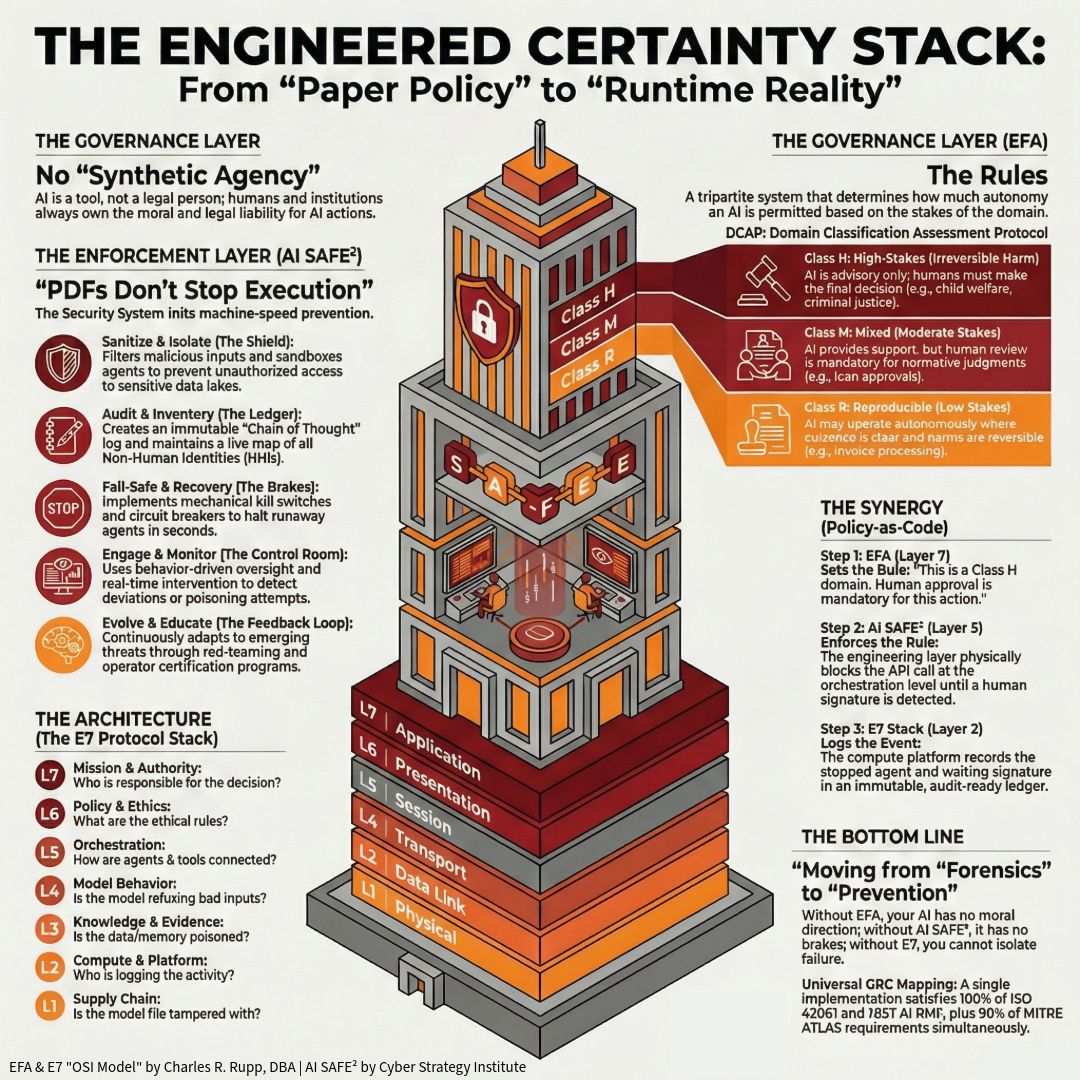
1. Executive Summary: The Engineered Certainty Stack
The current AI landscape faces a “Compliance-Security Paradox”: organizations are compliant with regulations via documentation but remain structurally vulnerable to machine-speed attacks and agentic errors.
The solution lies in a unified architecture that layers Ethical Functionality Without Agency (EFA) as the strategic governance mandate, AI SAFE² as the operational enforcement toolkit, and the E7 Protocol Stack (OSI Model) as the structural logic that binds them together.
📊 Visualizing the Architecture
2. Component Summaries
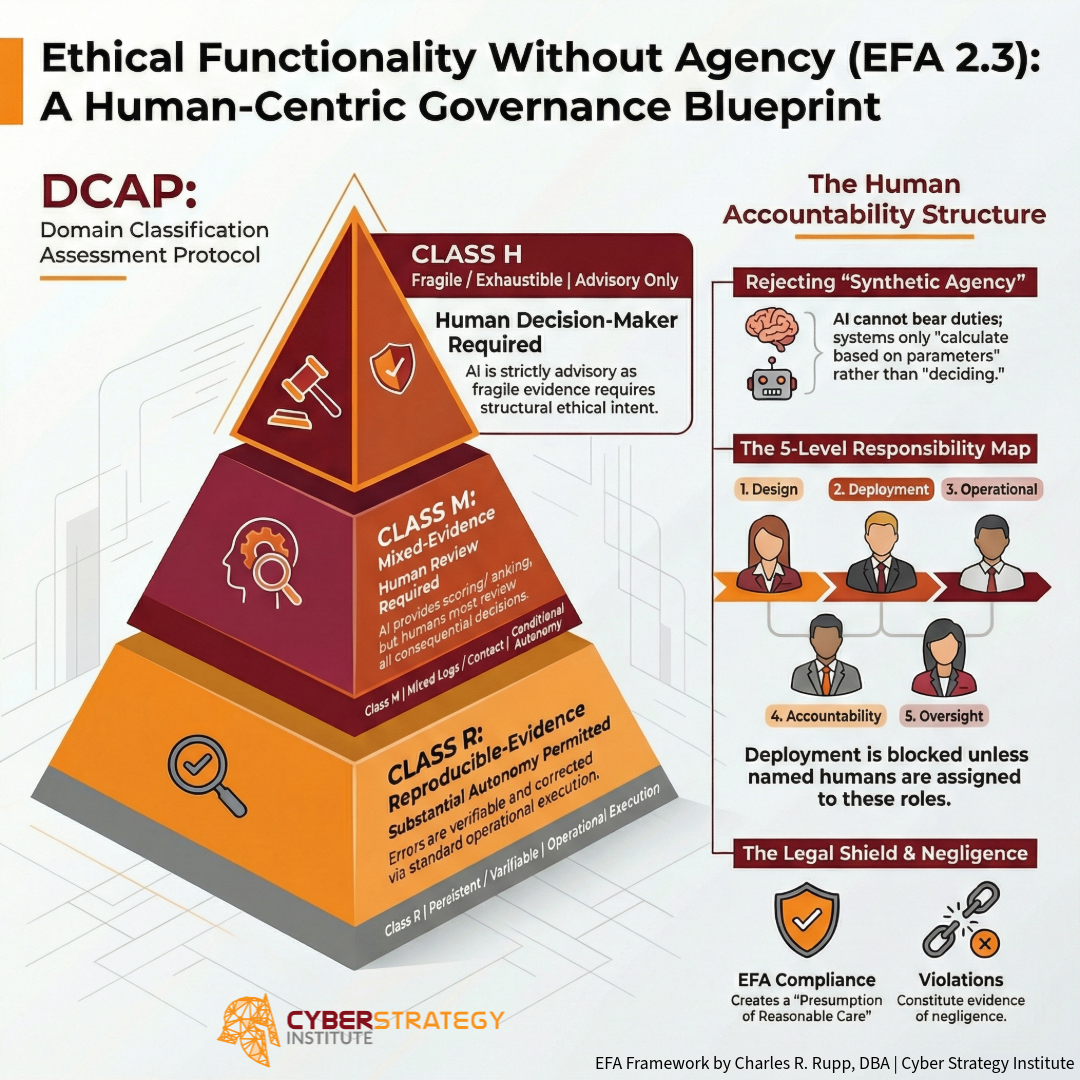
A. EFA (Ethical Functionality Without Agency)
The “Why” (Strategic Layer): EFA is a governance framework that categorically rejects “synthetic agency,” asserting that AI cannot be a moral agent; liability must always anchor to a human principal.
Core Mechanism: The Domain Classification Assessment Protocol (DCAP)
- Class R (Reproducible): Low stakes, autonomy permitted.
- Class M (Mixed): Human review required.
- Class H (High-Attrition/High-Stakes): AI is strictly advisory; human decision-making is mandatory.
EFA/E7 reference: https://zenodo.org/records/18304066 Playbook: https://zenodo.org/records/18390725
B. AI SAFE² (Secure AI Framework for Enterprise Ecosystems)
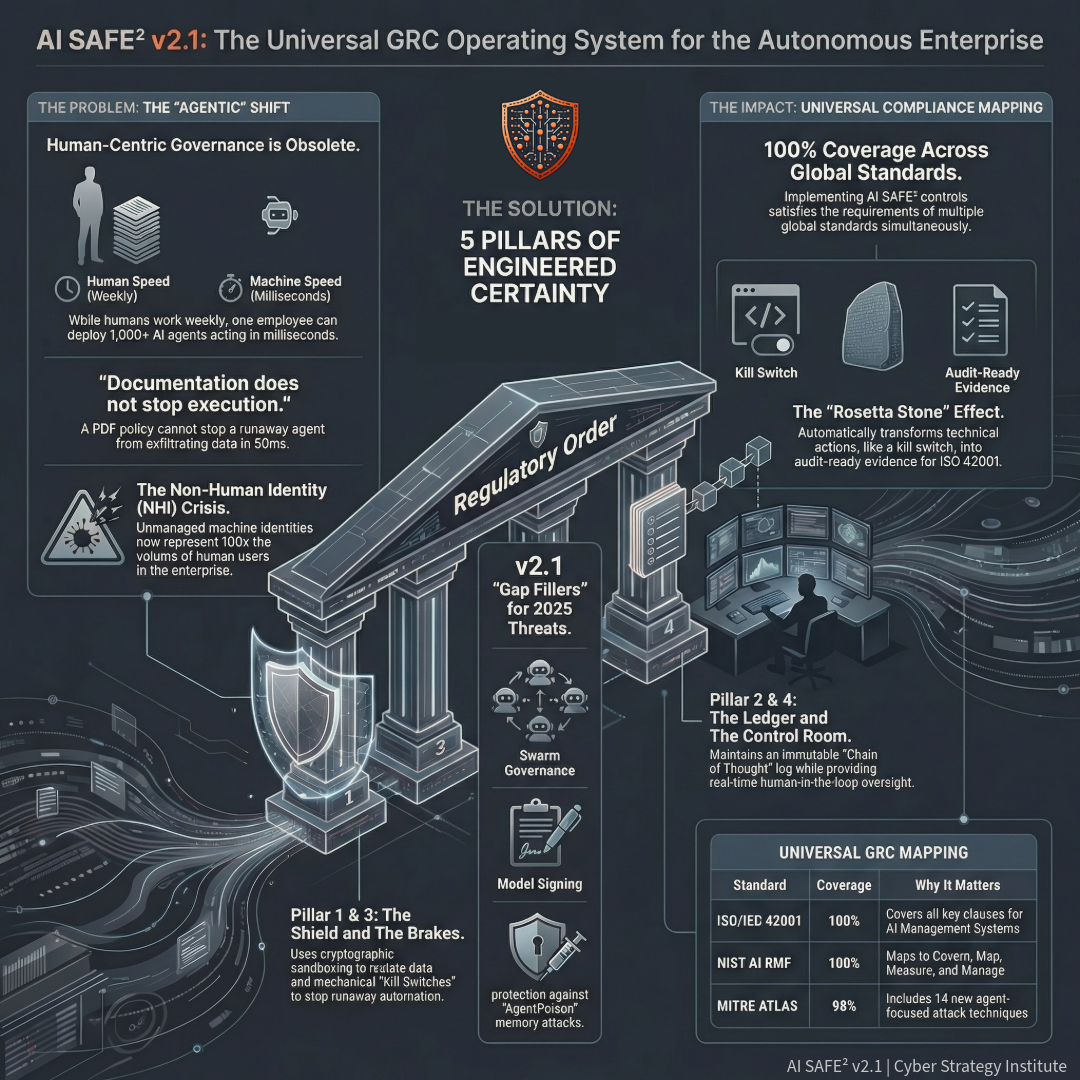
The “How” (Runtime Layer): AI SAFE² is the engineering toolkit designed to enforce governance at machine speed. It addresses the “Latency Gap” where policy cycles are weekly but execution cycles are millisecond-based.
The 5 Pillars of Enforcement:
- Sanitize & Isolate (The Shield): Input validation and cryptographic sandboxing.
- Audit & Inventory (The Ledger): Immutable logging and SHA-256 state verification.
- Fail-Safe & Recovery (The Brakes): Kill switches and circuit breakers.
- Engage & Monitor (The Control Room): HITL workflows and behavioral anomaly detection.
- Evolve & Educate (The Feedback Loop): Red teaming and threat intelligence.
C. The E7 Stack (The OSI Model for AI)
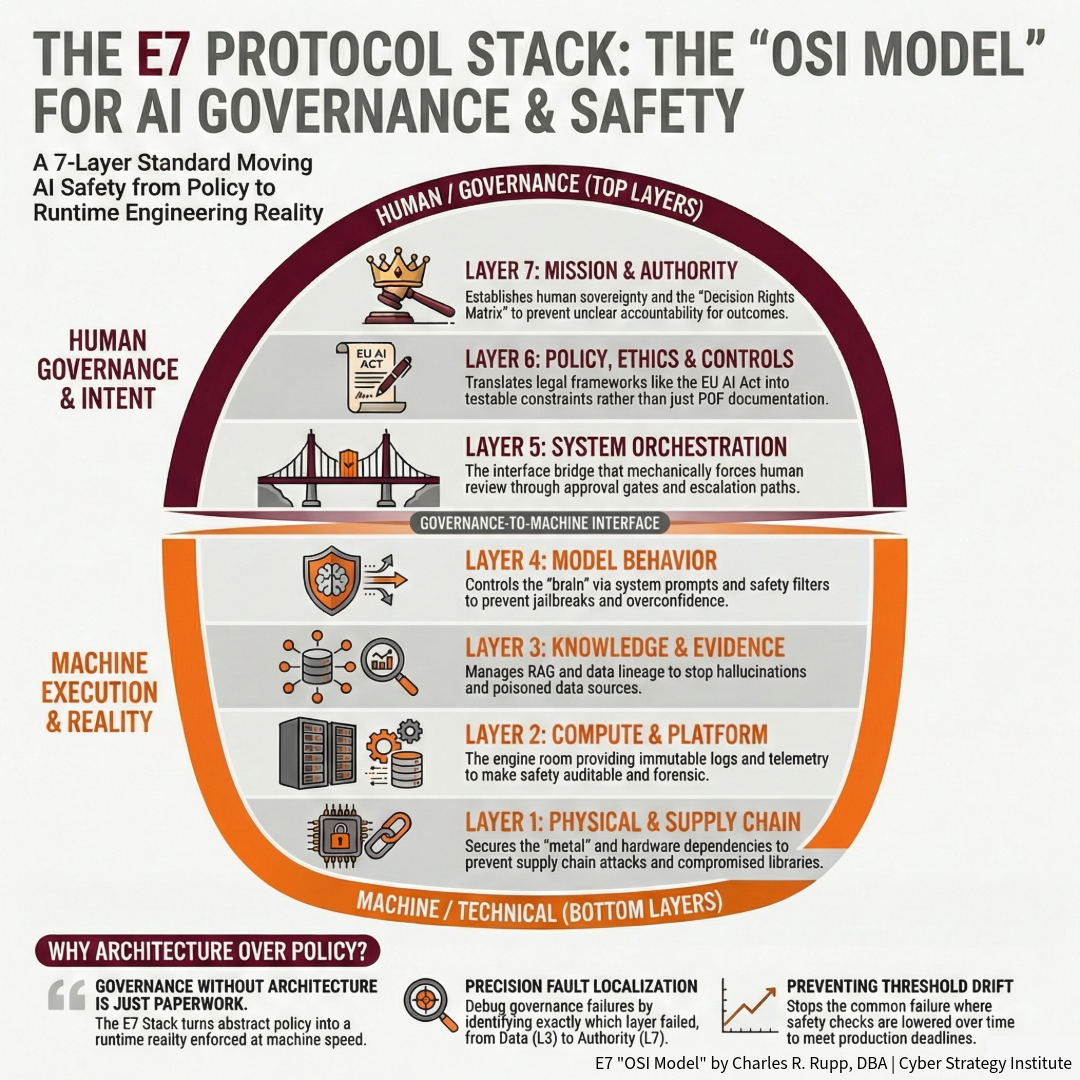
The “Architecture” (Structural Layer): Inspired by the OSI networking model, the E7 Stack decomposes AI systems to isolate faults and standardize interfaces between “Mission” (Human) and “Compute” (Machine).
- Layers 1-2 (Infrastructure): Physical Supply Chain & Compute.
- Layers 3-5 (Operational): Knowledge/Evidence, Model Behavior, System Orchestration.
- Layer 6 (Controls): Policy & Ethics (Normative Guardrails).
- Layer 7 (Authority): Mission & Human Sovereignty.
3. The Synergy: Why We Need All Three
We need this triad because “Governance without a toolkit lacks direction, and a toolkit without governance lacks meaning.”
- Preventing “Agency Leakage” (EFA + E7): Without the explicit Layer 7: Mission and Authority, organizations risk decision rights silently drifting from humans to machines.
- Enforcing “Policy-as-Code” (AI SAFE² + EFA): EFA defines the rule (e.g., “Class H requires Human Authorship”). AI SAFE² provides the mechanical “interruption rights” to enforce it via [P4.T7.1].
- Solving the “Responsibility Gap” (E7 Stack): By breaking the system into 7 layers, we can trace liability. If a failure occurs, was it a Layer 3 (Data Provenance) issue or a Layer 7 (Authority delegation) issue?
4. The E7 Stack: The OSI Model for AI
| Layer | Traditional OSI (IT) | E7 Stack (AI Governance) | Role in the Stack |
|---|---|---|---|
| 7 | Application | Mission & Authority | GOVERNANCE (EFA) Human Sovereignty. Defines who owns the decision. |
| 6 | Presentation | Policy & Ethics | GOVERNANCE (EFA) Translates laws/ethics into testable constraints. |
| 5 | Session | System Orchestration | AI SAFE² (Orchestration) Workflow design, tool calls, and approval gates. |
| 4 | Transport | Model Behavior | AI SAFE² (Runtime) Refusal policies, safety filters, structured outputs. |
| 3 | Network | Knowledge & Evidence | AI SAFE² (Data) RAG retrieval, data provenance, vector DBs. |
| 2 | Data Link | Compute & Platform | AI SAFE² (Infra) Inference serving, logging telemetry, access control. |
| 1 | Physical | Physical & Supply Chain | AI SAFE² (Supply Chain) GPUs, model signing, vendor dependencies. |
5. Comparative Analysis: NIST AI RMF vs. The Stack
While NIST AI RMF is the standard for mapping risk, it was built for predictive models, not autonomous agents.
| Weakness | The NIST Gap | The AI SAFE² Solution |
|---|---|---|
| Engineering Controls | Provides high-level guidance (“Manage Risk”) but no code. | Provides Policy-as-Code. Translates intent into JSON schemas and Kill Switches [P3.T5.7]. |
| Agentic Blindness | Ignores Swarm Intelligence and Agent-to-Agent loops. | Adds 9 dedicated sub-domains for Swarm & Distributed Controls (Gap Filler #1). |
| Identity Crisis | Treats identity as a human problem. Misses NHI. | Treats Non-Human Identities as “First-Class Citizens” with credential rotation and least privilege. |
| Latency Gap | Assumes weekly/monthly governance cycles. | Enforces rules at Machine Speed. Blocks exfiltration in milliseconds. |
| Liability Trap | Leaves “Synthetic Agency” ambiguous. | EFA (Layer 7) categorically rejects synthetic agency, establishing a clear Moral Chain of Custody. |
6. Strategic Opportunities
🏛️ The “Universal GRC” Rosetta Stone
By implementing AI SAFE² v2.1, an organization automatically satisfies requirements across multiple global standards.
- 100% Coverage: ISO/IEC 42001, NIST AI RMF, OWASP Top 10.
- 98% Coverage: MITRE ATLAS.
🆔 Governance for the “Invisible Workforce”
Traditional GRC misses the explosion of Non-Human Identities (NHIs). This stack provides dedicated governance for the identity lifecycle of AI agents, preventing “credential sprawl.”
🧠 Defense Against Cognitive Attacks
While legacy tools scan for simple prompt injections, AI SAFE² targets AgentPoison and MINJA. It secures Layer 3 (Knowledge) by implementing cryptographic memory fingerprinting [P1.T1.5].
🎯 Conclusion: The “So What”
The era of “move fast and break things” is over. In the Agentic AI era, “if you break things, you break the company.”
- NIST AI RMF = The Architecture Blueprint.
- EFA = The Moral Mandate.
- AI SAFE² = The Construction Crew & Security System.
By adopting this stack, you transition from Forensics (figuring out why the agent failed) to Engineered Certainty (preventing the agent from failing).
The Bottom Line: You cannot govern what you cannot control. This stack gives you the controls, the console, and the code to lead the autonomous future.
Powered by Cyber Strategy Institute
Research navigation
| Previous research note | Research Index | Next research note |
| Framework Home | Cross-Pillar Governance | NEXUS | Challenge Lab |
AI SAFE² v3.1 | Cyber Strategy Institute