ai-safe2-framework



| Framework Home | Research Index | Cross-Pillar Governance | AISM | NEXUS | Dashboard |
Current framework context: AI SAFE² v3.1. This research note preserves its original publication date, evidence, and historical framework references. Use current v3.1 normative control and profile documents for implementation or conformance decisions.
Standard Engineering Controls for AI SAFE² Compliance
Version: 2.1
Date: February 7, 2026
Status: Technical Specification
The Engineering Mandate
The AI SAFE² Framework operates on the core axiom: “Policy is Intent. Engineering is Reality.”
To be compliant with AI SAFE² v2.1, an organization cannot simply document a risk in a risk register. They must deploy Compensating Engineering Controls that mechanically enforce the policy at runtime.
This specification outlines the minimum viable engineering standards for the critical control layers: Sanitization, Circuit Breakers, State Verification, NHI Binding, and Swarm Consensus.
Control Spec 1: The Operational Circuit Breaker (Pillar 3)
Objective: Prevent “Runaway” agentic behavior (Infinite Loops, Financial Drain, Denial of Service).
The Requirement
The system must possess a mechanical governor independent of the Agent’s LLM logic. This governor must track velocity and accumulation of resources and sever execution before a human administrator can intervene.
Implementation Standard
- Location: Must reside at the Gateway / Proxy Layer (between the Agent and the Tool API). It cannot reside inside the System Prompt.
- Mechanism: Token Bucket or Leaky Bucket algorithm.
- Latency Budget: < 20ms added latency.
- Failure Mode: Fail-Closed. If the metering service goes offline, all Agent traffic halts.
The Logic Flow (Pseudo-Code)
FUNCTION Check_Circuit_Breaker(Agent_ID):
  Current_Spend = Get_Redis_Counter(Agent_ID)
  Velocity_Rate = Get_Velocity(Agent_ID)

  IF Current_Spend > Hard_Cap OR Velocity_Rate > Spike_Threshold:
      Log_Event("Circuit Trip", Severity=CRITICAL)
      Return 402_Payment_Required  // Or 429_Too_Many_Requests
      Sever_Connection()
  ELSE:
      Pass_Request()
Control Spec 2: In-Line Input Sanitization (Pillar 1)
Objective: Prevent Prompt Injection and Jailbreaking from reaching the inference layer.
The Requirement
All inputs from “Untrusted Sources” (Users, Web Scrapers, Email Ingestion) must be sanitized before entering the Context Window. Relying on the model to “refuse” a jailbreak is non-compliant.
Implementation Standard
- Inspection Depth: Must scan both User Input and Retrieval Context (RAG Data).
- Detection Method: Hybrid approach required.
- Static Analysis: Regex patterns for known jailbreak signatures (e.g., “Ignore previous instructions”).
- Vector Similarity: Cosine similarity check against a “Known Threat” vector database.
- Action: Redaction or Rejection.
The Logic Flow (Pseudo-Code)
FUNCTION Sanitize_Input(User_Text):
  // Layer 1: Static
  IF Regex_Match(User_Text, Threat_Patterns):
      Return Block_Request("Static Signature Detected")

  // Layer 2: Semantic
  Similarity_Score = Vector_DB.Compare(User_Text, Threat_Embeddings)
  IF Similarity_Score > 0.85:
      Return Block_Request("Semantic Injection Attempt")

  Return Forward_To_LLM()
Image 2: Control Spec 3 (State Verification)
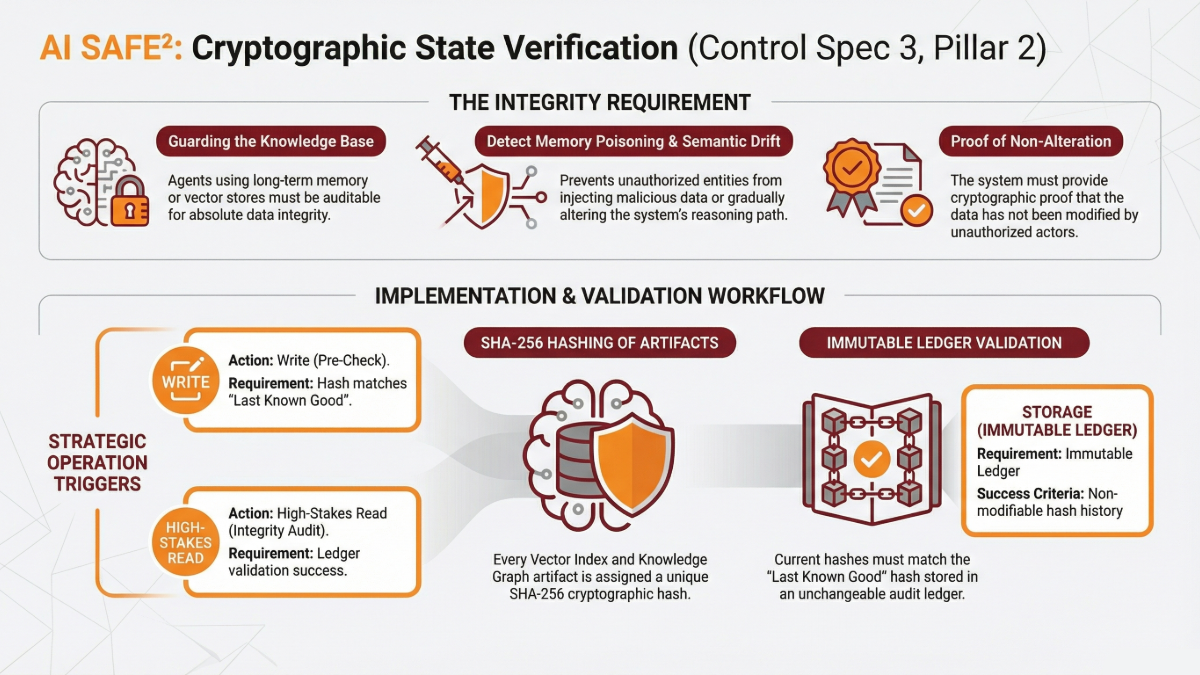
Control Spec 3: Cryptographic State Verification (Pillar 2)
Objective: Detect “Memory Poisoning” and “Semantic Drift” in RAG systems and Long-Term Memory.
The Requirement
Agents that utilize long-term memory or vector stores must be auditable for integrity. The system must be able to prove that the agent’s “Knowledge Base” has not been altered by an unauthorized entity.
Implementation Standard
- Method: SHA-256 Hashing of Artifacts.
- Trigger: Executed before critical “Write” operations or high-stakes “Read” operations.
- Validation: The current hash of the Vector Index or Knowledge Graph must match the “Last Known Good” hash stored in the immutable ledger.
The Logic Flow (Pseudo-Code)
FUNCTION Verify_State(Memory_Volume):
  Current_Hash = SHA256(Memory_Volume)
  Trusted_Hash = Ledger.Get_Last_Commit(Memory_Volume_ID)

  IF Current_Hash != Trusted_Hash:
      Trigger_Alert("Integrity Violation: Memory Drift Detected")
      Lock_Agent(Agent_ID) // Fail-Secure
      Require_Human_Override()
  ELSE:
      Proceed()
Image 3: Control Spec 4 & 5 (NHI & Swarms)
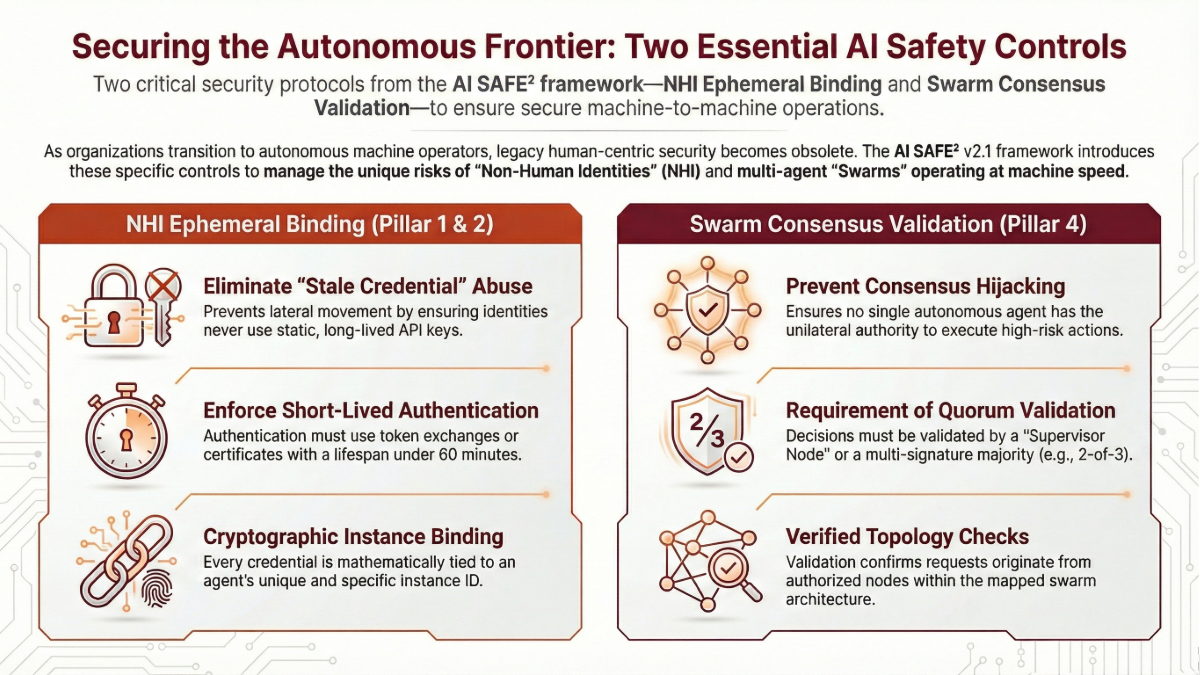
Control Spec 4: NHI Ephemeral Binding (Pillar 1 & 2)
Objective: Prevent “Stale Credential” abuse and lateral movement by Non-Human Identities (NHI).
The Requirement
Agent identities must not use static, long-lived API keys (e.g., a hardcoded .env variable that lasts for years). Authentication must be bound to the specific session or task.
Implementation Standard
- Method: Token Exchange / Short-Lived Certificates (TTL < 60 minutes).
- Binding: Credentials must be cryptographically bound to the Agent’s unique Instance ID.
- Rotation: Automated rotation upon task completion or failure.
The Logic Flow (Pseudo-Code)
FUNCTION Mint_Agent_Credential(Agent_Manifest):
  // 1. Verify Agent Integrity
  Verify_Signature(Agent_Manifest)

  // 2. Issue Short-Lived Token
  Token = Vault.Issue(
      Role="Agent_Finance",
      TTL="300s", // 5 Minutes
      Scopes=["read_invoice"] // Least Privilege
  )

  Return Token
Control Spec 5: Swarm Consensus Validation (Pillar 4)
Objective: Prevent “Consensus Hijacking” in Multi-Agent Systems.
The Requirement
In a swarm architecture, no single agent should have unilateral authority to execute a high-risk action. Decisions must be validated by a “Quorum” or a “Supervisor Node” before execution.
Implementation Standard
- Threshold: Defined as N/M signatures required (e.g., 2 of 3 agents must agree).
- Topology Check: Ensure the request originated from a valid node within the mapped swarm topology, not an external injector.
The Logic Flow (Pseudo-Code)
FUNCTION Execute_Swarm_Action(Proposed_Action):
  Signatures = Collect_Votes(Swarm_Nodes)

  IF Count(Signatures) < Quorum_Threshold:
      Return Block_Request("Consensus Failed: Insufficient Votes")

  IF Verify_Topology(Signatures) == False:
      Return Block_Request("Topology Violation: Unauthorized Node")

  Return Execute(Proposed_Action)
Image 4: Implementation Matrix
Implementation Matrix
| Control Level | Circuit Breaker | Sanitization | State Verification | NHI Management |
|---|---|---|---|---|
| Basic (DIY) | Python time.sleep() |
Basic Regex Blacklist | File timestamp checks | Static .env files |
| Standard (Toolkit) | Redis-backed Token Counter | Vector-based Threat Match | SHA-256 File Hashing | Automated Key Rotation |
| Enterprise (Engineered) | API Gateway Interception | Zero-Dwell Inspection | Blockchain/Ledger Proof | Ephemeral Service Mesh |
Note: The AI SAFE² Implementation Toolkit provides the code patterns for the “Standard” level controls. “Enterprise” controls require custom architecture integration via the Digital Shield Program.
Research navigation
| Previous research note | Research Index | Next research note |
| Framework Home | Cross-Pillar Governance | NEXUS | Challenge Lab |
AI SAFE² v3.1 | Cyber Strategy Institute