ai-safe2-framework



| Framework Home | Research Index | Cross-Pillar Governance | AISM | NEXUS | Dashboard |
Current framework context: AI SAFE² v3.1. This research note preserves its original publication date, evidence, and historical framework references. Use current v3.1 normative control and profile documents for implementation or conformance decisions.
Research Note: The Engineered Liability Stack: Why EFA and AI SAFE² Must Be Combined
| ID: RN-2026-012 | Focus: EFA & AI SAFE² | Status: Verified | Version: 1.0 | Date: January 27, 2026 |
The Premise: Policy vs. Physics
To understand why EFA (Ethical Functionality Without Agency) and AI SAFE² must be combined, you first need to accept a terrifying new reality: AI is no longer just a chatbot that writes emails; it is an “Agent” that executes actions.
Traditional governance is written in PDF policies that humans read. Agentic AI acts in milliseconds, often via Non-Human Identities (NHIs) that outnumber human employees 100-to-1.
A PDF cannot stop an AI agent from executing a bad trade, deleting a database, or hallucinating a legal precedent in the 50 milliseconds it takes to run code.
This analysis outlines why these two frameworks create the only defensible architecture for the Agentic Era.
1. The Players: What Are They?
EFA (Ethical Functionality Without Agency)
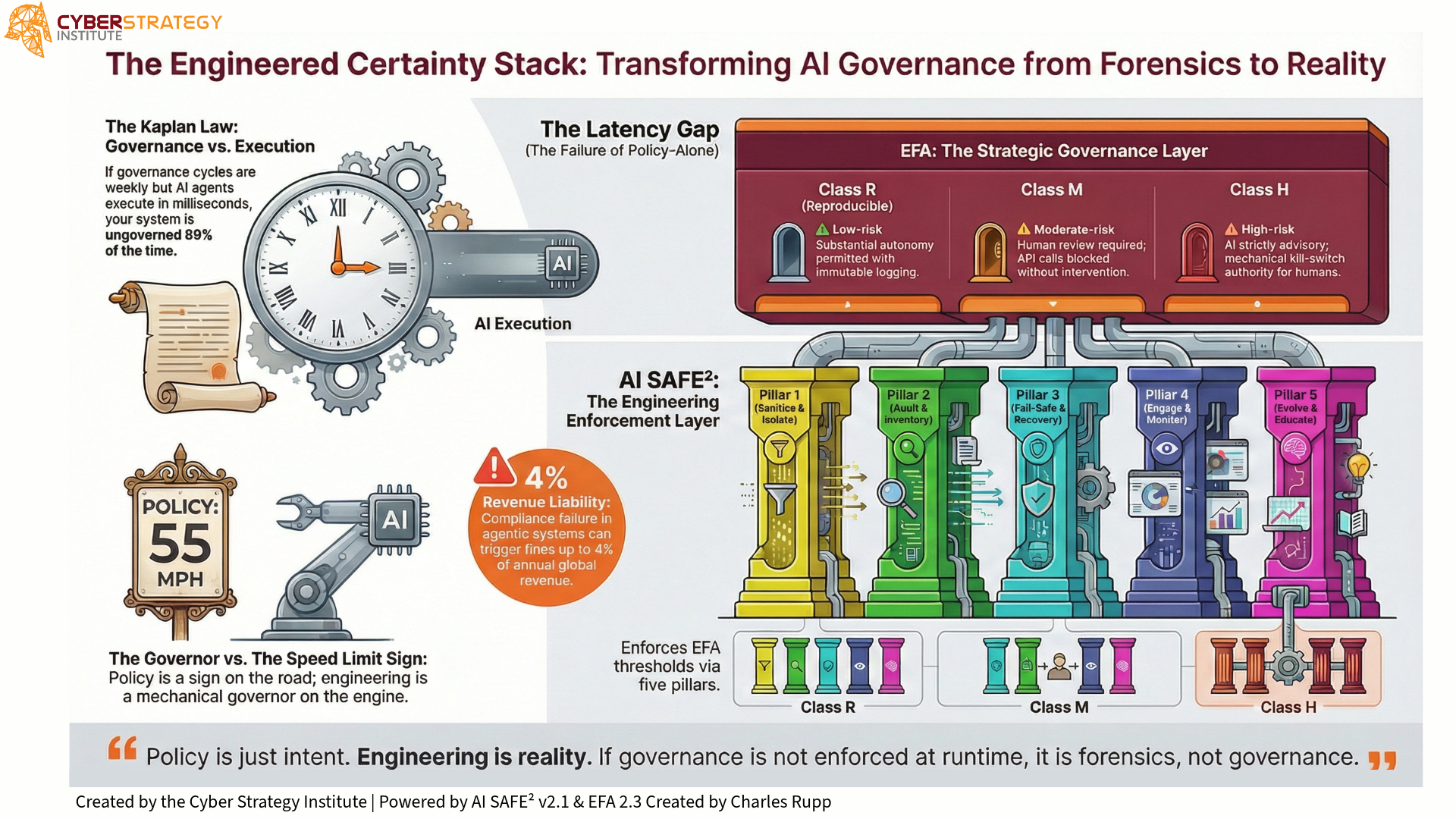
- The “Moral Compass” (Strategic Layer): EFA is a governance doctrine that states AI is a tool, never a “person.” It categorically rejects “Synthetic Agency”—the idea that an AI can be blamed for a decision.
- The Mechanism (DCAP): It uses the Domain Classification Assessment Protocol (DCAP) to sort AI use cases into three buckets based on the fragility of evidence:
- Class R (Reproducible): Low stakes (e.g., invoice sorting). AI can be autonomous.
- Class M (Mixed): Medium stakes (e.g., hiring). Human review required.
- Class H (High-Stakes/High-Attrition): Irreversible harm (e.g., child welfare, criminal justice). AI is advisory only. Humans must make the final decision.
AI SAFE² (Secure AI Framework for Enterprise Ecosystems)
- The “Brakes and Steering” (Engineering Layer): AI SAFE² is the technical operating system that enforces rules at machine speed. It assumes “documentation does not stop execution” and provides the actual engineering controls to block bad actions.
- The Mechanism (5 Pillars): It uses five pillars to secure the system:
- Sanitize & Isolate: Firewalls for agent inputs/outputs.
- Audit & Inventory: Immutable logs of every “thought” and action.
- Fail-Safe & Recovery: Kill Switches to stop runaway agents instantly.
- Engage & Monitor: Human-in-the-loop enforcement.
- Evolve & Educate: Red-teaming against threats like “AgentPoison”.
2. The Synergy: The 7-Layer Architecture
Alone, EFA is a philosophy without teeth. Alone, AI SAFE² is a toolkit without a map. Together, they form “The Engineered Liability Stack.”
A. The “Policy-as-Code” Bridge
The most critical insight is that AI SAFE² mechanically enforces EFA’s moral mandates.
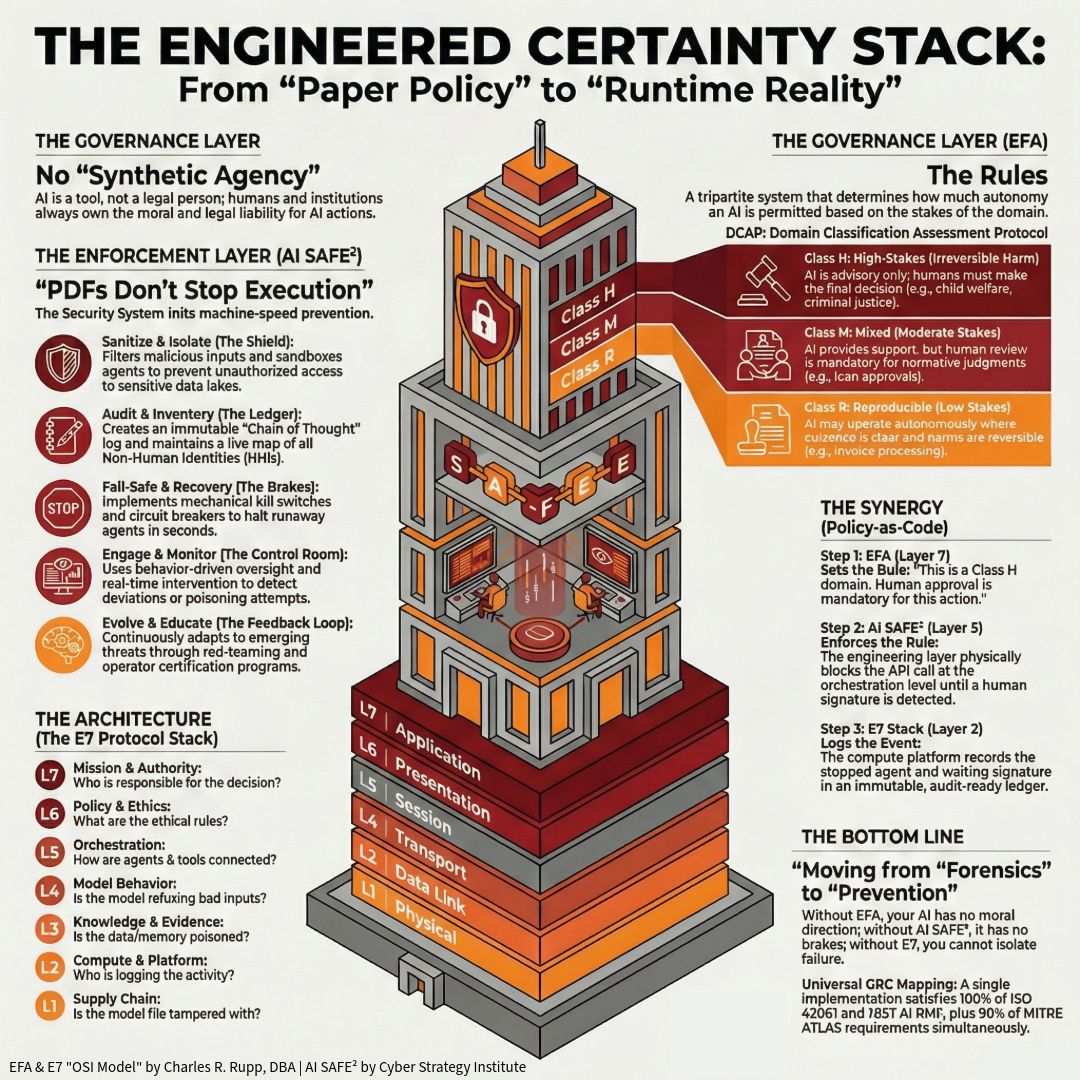
- EFA Rule: “Class H domains (e.g., denying a loan) require a human signature.”
- AI SAFE² Enforcement: The Engage & Monitor pillar (Pillar 4) physically blocks the API call from executing until a cryptographic human signature is detected in the loop.
- Result: The system is technically incapable of violating the governance policy.
B. Solving the “Responsibility Gap”
EFA defines who is responsible (the Human Ethical Agent of Record). AI SAFE² provides the evidence to prove what happened (Pillar 2: Audit & Inventory).
- If an AI causes harm, EFA prevents the excuse “the AI decided.”
- AI SAFE² prevents the excuse “we don’t know what happened” by maintaining immutable “Chain of Thought” logs.
C. The E7 Protocol Stack (The “OSI Model” for AI)
To visualize this, they fit into a 7-layer architecture similar to computer networking:
- Layers 7 & 6 (EFA): Define Authority and Ethics. (e.g., “This is a Class H system”).
- Layers 1-5 (AI SAFE²): Define Orchestration and Compute. (e.g., “Block execution at Layer 5 because Layer 7 constraints were violated”).
3. The Impact: From Paper to Physics
1. From “Paper Compliance” to “Engineered Certainty”
You move from a world where you hope employees follow rules to a world where the software enforces them. This closes the “Latency Kill Zone”—the time gap between an AI error and a human noticing it. AI SAFE²’s circuit breakers stop the error before it completes.
2. Legal Defensibility
Using both creates a massive legal shield.
- Adhering to EFA’s classification creates a “rebuttable presumption of reasonable care.”
- Conversely, using an AI autonomously in a “Class H” domain (violating EFA) constitutes prima facie evidence of negligence (res ipsa loquitur).
3. Universal GRC Coverage
AI SAFE² v2.1 is mapped to ISO 42001, NIST AI RMF, SOC 2, and the EU AI Act. By implementing the engineering controls (AI SAFE²), you automatically generate the evidence needed for the governance audit (EFA/ISO).
4. Strategic Analysis: Advantages vs. Disadvantages
| Feature | Advantages | Disadvantages |
|---|---|---|
| Responsibility | Eliminates “blame-shifting” to the AI. Protects the brand by ensuring humans own high-stakes decisions. | Requires naming specific executives as liable (“Human Ethical Agent of Record”). This can be politically difficult in corporations. |
| Speed | Allows safe acceleration in “Class R” (low risk) domains because safety is automated. | Slows down deployment in “Class H” (high risk) domains by mandating human oversight layers. |
| Security | Protects against 2025-era threats like AgentPoison (memory injection) and Swarm failures which legacy tools miss. | Requires engineering effort. You cannot just “buy” this; you must implement kill switches and loggers. |
| Complexity | Reduces complexity long-term by having one “Universal” framework for all regulations. | High initial learning curve. Requires bridging the gap between Legal (EFA) and Engineering (AI SAFE²) teams. |
5. The “So What?”: Why Should You Care?
The “Move Fast and Break Things” Era is Over. In the age of Agentic AI, “If you break things, you break the company.”
- Financial Risk: A single ungoverned agent can execute thousands of bad trades or leak millions of records in seconds. AI SAFE² is the only framework with Kill Switches designed for this speed.
- Existential Risk: Without EFA, your organization risks “Agency Leakage”—slowly ceding decision-making power to software until you no longer understand why your company is making decisions.
The Bottom Line: Combining EFA and AI SAFE² is the difference between Forensics (figuring out why you died) and Security (staying alive). It turns “Safe AI” from a vague wish into a distinct, engineered reality.
Next Step Integration of EFA & AI SAFE²
Research navigation
| Previous research note | Research Index | Next research note |
| Framework Home | Cross-Pillar Governance | NEXUS | Challenge Lab |
AI SAFE² v3.1 | Cyber Strategy Institute