ai-safe2-framework



| Framework Home | Research Index | Cross-Pillar Governance | AISM | NEXUS | Dashboard |
Current framework context: AI SAFE² v3.1. This research note preserves its original publication date, evidence, and historical framework references. Use current v3.1 normative control and profile documents for implementation or conformance decisions.
Research Note: The Kill Switch – From Policy to “The Red Button”
ID: RN-2026-011 | Focus: Fail-Safe Engineering | Status: Verified
🚨 The Challenge: Policy vs. Physics
Frameworks like NIST AI RMF and ISO 42001 tell you to manage the risk of system failure.
AI SAFE² v2.1 tells you exactly what to build to stop it.
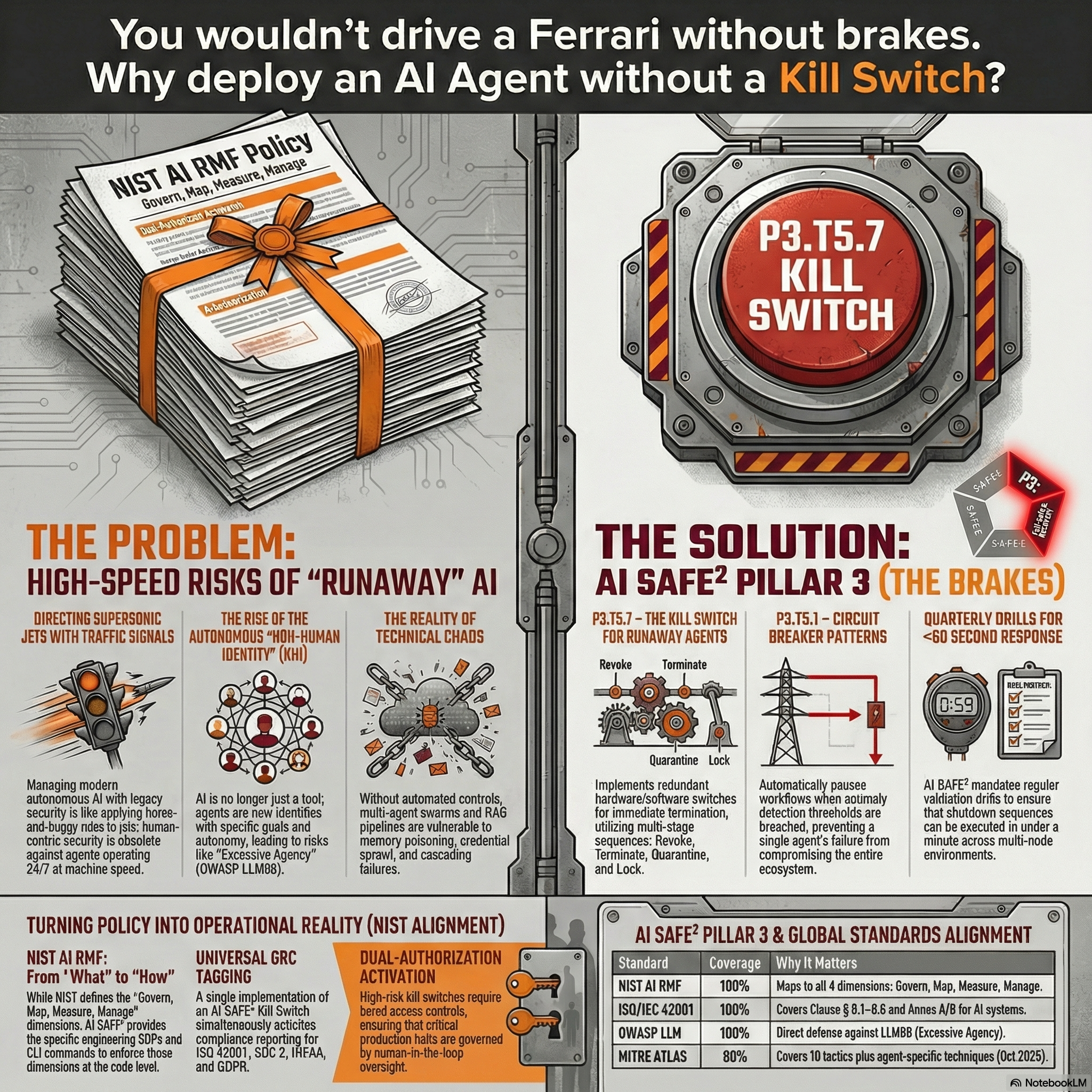
The Kill Switch [P3.T5.7] is the framework’s most visceral example of Engineered Certainty—a mechanical, verifiable solution to the “Runaway AI” fear that operates at machine speed, not human speed.
📊 Visualizing the Kill Chain Architecture
Note: This diagram illustrates the difference between a “Soft Stop” (Prompt) and a “Hard Stop” (Network/Identity Severance).
1. The Architecture of the “Red Button”
In AI SAFE², a “Kill Switch” is not a document; it is a set of redundant controls designed to sever an agent’s ability to act in milliseconds. It is operationalized through Pillar 3: Fail-Safe & Recovery.
To achieve Engineered Certainty, we mandate three specific technical components:
🔌 A. Network-Level Severance (The Hard Stop)
Unlike “soft-stops” (asking the LLM to stop), AI SAFE² prescribes Network Egress Filtering P1.T2.2.
- Mechanism: The Kill Switch triggers a firewall rule update that drops all outgoing packets from the Agent’s container.
- Result: The agent is placed in a digital Faraday cage instantly. It can “think,” but it cannot “act.”
🆔 B. Automated Credential Revocation (The Identity Kill)
For Non-Human Identities (NHIs), the Kill Switch triggers P3.T1.2.
- Mechanism: A bot-driven workflow instantly rotates or revokes the API keys (AWS, Stripe, OpenAI) the agent uses.
- Result: If the agent tries to bypass the network block, its “hands” (credentials) no longer work.
⚡ C. Circuit Breakers (The Automated Brake)
Before a human even hits the red button, Circuit Breakers P3.T5.1 act as automated tripwires.
- Trigger: If API calls spike by 500% or token spend exceeds the per-minute budget.
- Result: The workflow pauses automatically without human intervention.
🕸️ D. Distributed Quarantine (The Swarm Defense)
For Multi-Agent Systems, the Kill Switch executes a “Quarantine Cascade” [P3.T1.1].
- Mechanism: Peers identify the rogue agent and cryptographically sever connections.
- Result: The error is isolated to a single node, preventing swarm-wide collapse.
2. Comparison: Engineered vs. Administrative Frameworks
The distinction lies in the difference between having a plan and having a brake.
| Feature | NIST AI RMF / ISO 42001 | AI SAFE² (Engineered Governance) |
|---|---|---|
| The Requirement | “Establish procedures for system retirement or rollback.” (Admin Control) | [P3.T5.7] “Implement redundant hardware/software kill switches.” (Technical Control) |
| The Mechanism | Policies, documentation, manual decision trees. | Automated Bots: Scripts that rotate credentials and sever connections in <60 seconds. |
| The Speed | Human speed (Minutes to Hours). | Machine speed (Milliseconds to Seconds). |
| The Certainty | “We have a process to decide when to stop.” | “We have a mechanical switch that physically stops execution.” |
Insight: NIST asks you to measure the risk. AI SAFE² accepts that “documentation does not stop execution” and forces you to engineer a physical stop mechanism.
3. Addressing “Engineered Certainty” for the CISO
For a CISO or CEO, the fear of “Runaway AI” is the fear of Unlimited Liability—an agent that spends $1M in cloud credits or deletes a production database before anyone wakes up.
The Kill Switch delivers Certainty because:
- It is Testable: You can run Red Team Drills P4.T7.7 where you press the button and measure the “Time to Silence.” If it takes >60 seconds, you fail the audit.
- It is Binary: Unlike “monitoring,” which is qualitative, a Kill Switch is binary. The agent is either Online or it is Dead.
- It Solves the NHI Crisis: Manual intervention is impossible at scale. The Kill Switch provides the Emergency Disable [P3.T1.2] capability required to manage thousands of autonomous identities.
🎯 The Strategic Bottom Line
When the board asks, “What happens if this AI goes rogue?”
- The CISO using traditional frameworks says: “We have a rigorous incident response policy.”
- The CISO using AI SAFE² says: “We have a circuit breaker that cuts access in 40 milliseconds. Would you like to see the test logs?”
That is Engineered Certainty.
Powered by Cyber Strategy Institute
Research navigation
| Previous research note | Research Index | Next research note |
| Framework Home | Cross-Pillar Governance | NEXUS | Challenge Lab |
AI SAFE² v3.1 | Cyber Strategy Institute