ai-safe2-framework



| Framework Home | Research Index | Cross-Pillar Governance | AISM | NEXUS | Dashboard |
Current framework context: AI SAFE² v3.1. This research note preserves its original publication date, evidence, and historical framework references. Use current v3.1 normative control and profile documents for implementation or conformance decisions.
Research Note: Governing the 10 Core Types of AI Agents
ID: RN-2026-010 | Focus: Agent Taxonomy & Control Mapping | Status: Verified
🚨 The Challenge: Beyond Static Definitions
Traditional AI governance treats models as static tools—calculators that output text. This definition is obsolete.
The AI SAFE² Framework v2.1 redefines these entities. From our viewpoint, agents are not just software; they are Non-Human Identities (NHIs) and Machine Operators.
To secure them, we must frame them based on their autonomy, statefulness, and interaction complexity.
📊 Visualizing the Agent Governance Model
(Place your “10 Agent Types vs. 5 Pillars” Infographic here)
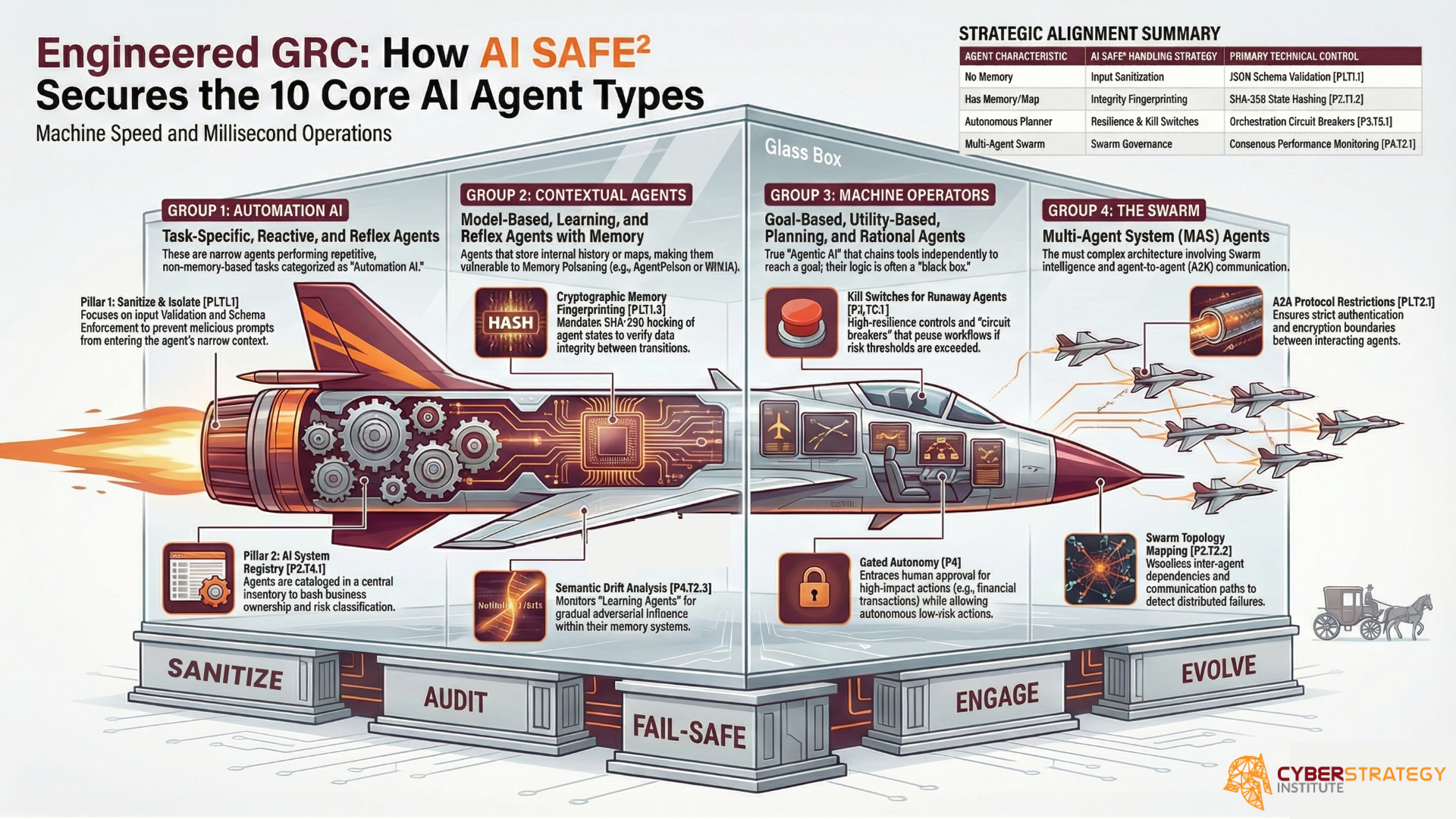
Note: This diagram illustrates how control density increases as agent autonomy moves from “Reactive” to “Swarm.”
📋 The Agent Taxonomy Matrix
We classify the 10 core types of real-world agents into four Governance Groups. This ensures that security controls are applied proportionally to the agent’s autonomy and risk profile.
| Agent Type | Operational Definition | AI SAFE² Grouping |
|---|---|---|
| Task-Specific | Built for one focused task (e.g., summarizing, translating). Follows a fixed process with no adaptation. | Automation AI |
| Reactive | Responds to immediate input without using memory or history. It functions as a reflex, not a planner. | Automation AI |
| Reflex w/ Memory | Uses preset rules but retains a memory window of past inputs to handle repeating or evolving situations. | Contextual |
| Model-Based | Builds an internal map of its environment. Simulates outcomes before acting to make context-aware decisions. | Contextual |
| Learning | Improves over time by learning from past actions. Adjusts strategy using feedback and stores new knowledge. | Contextual |
| Goal-Based | Starts with a goal and works backward. It plans steps, simulates paths, and selects the route to achieve the goal. | Machine Operator |
| Utility-Based | Chooses actions based on specific utility/benefit. Weighs all options and picks the highest value outcome. | Machine Operator |
| Planning | Focuses on long-term strategy. Defines a goal, maps steps, and adjusts based on progress, not just reaction. | Machine Operator |
| Rational | Selects the most logical option based on available data. Analyzes the full picture to predict and choose the smartest path. | Machine Operator |
| Multi-Agent | Works with or against other agents. They share environments, negotiate roles, and coordinate to reach a unified goal. | Swarm |
1. Handling Reactive & Task-Specific Agents
The “Automation AI” Group
- Target Agents: Task-Specific, Reactive.
- Operational Context: These are narrow “cogs in the machine” performing repetitive tasks without long-term memory or complex planning.
🛡️ The AI SAFE² Strategy: Since these agents have no memory to poison and no complex plan to hijack, governance focuses on Input Hygiene and Inventory.
- Sanitize & Isolate (P1): We rely on Input Validation & Schema Enforcement [P1.T1.1]. The goal is to ensure malicious prompts or secrets never enter the agent’s narrow context.
- Audit & Inventory (P2): Every automation script is cataloged in the AI System Registry [P2.T4.1] to track specific business owners and risk classification.
2. Handling State-Aware Agents
The “Contextual” Group
- Target Agents: Reflex Agent with Memory, Model-Based, Learning.
- Operational Context: These agents store history, user preferences, or internal maps. This statefulness makes them susceptible to Memory Poisoning attacks like AgentPoison or MINJA.
🛡️ The AI SAFE² Strategy: Governance shifts from input validation to State Integrity.
- Gap Filler #2 (Context & Fingerprinting): We mandate Cryptographic Memory Fingerprinting [P1.T1.5]. By taking SHA-256 hashes of agent states, we verify integrity between state transitions.
- Monitor (P4): We employ Semantic Drift Analysis [P4.T2.3] to detect if a “Learning Agent” is being gradually influenced by adversarial data injected into its vector memory.
3. Handling Strategy-Focused Agents
The “Machine Operator” Group
- Target Agents: Goal-Based, Utility-Based, Planning, Rational.
- Operational Context: These are true Agentic AI—”machine operators” given a high-level goal and the autonomy to chain tools independently. Their internal logic is often a “black box.”
🛡️ The AI SAFE² Strategy: Because we cannot predict every action, we wrap the agent in a “Glass Box” of Governance.
- Fail-Safe & Recovery (P3): High autonomy requires high safety. These agents require Kill Switches [P3.T5.7] and “Circuit Breakers” that pause workflows if utility-based decisions exceed a financial or risk threshold.
- Engage (P4): We enforce Gated Autonomy. For “Rational” agents, human approval is required for high-impact actions (e.g., executing a transaction), while low-risk actions remain autonomous.
4. Handling Multi-Agent Systems
The “Swarm” Group
- Target Agents: Multi-Agent Systems (MAS).
- Operational Context: The most complex architecture, involving Swarm Intelligence, distributed consensus, and agent-to-agent (A2A) negotiation.
🛡️ The AI SAFE² Strategy: Governance focuses on Distributed Failure and Boundary Enforcement.
- Gap Filler #1 (Swarm Controls): We apply A2A Protocol Restrictions [P1.T2.1] to ensure strict authentication and encryption between interacting agents.
- Inventory (P2): We require Swarm Topology Mapping [P2.T2.2] to visualize inter-agent dependencies. You cannot secure a swarm if you do not know who is talking to whom.
- Monitor (P4): We use Consensus Performance Tracking [P4.T2.1] to alert if a swarm fails to reach a logical decision or exhibits cascading hallucination loops.
🎯 Strategic Summary for Framework Alignment
| Agent Characteristic | AI SAFE² Handling Strategy | Primary Technical Control |
|---|---|---|
| No Memory | Input Sanitization | [P1.T1.1] JSON Schema Validation |
| Has Memory/Map | Integrity Fingerprinting | [P2.T1.2] SHA-256 State Hashing |
| Autonomous Planner | Resilience & Kill Switches | [P3.T5.1] Orchestration Circuit Breakers |
| Multi-Agent Swarm | Swarm Governance | [P4.T2.1] Consensus Performance Monitoring |
The Strategic Truth
AI risk executes in milliseconds. While these 10 types describe how an agent thinks, AI SAFE² engineers the boundaries to ensure that no matter how an agent plans or reacts, it operates at machine speed within a secure, audited, and recoverable environment.
Powered by Cyber Strategy Institute
Research navigation
| Previous research note | Research Index | Next research note |
| Framework Home | Cross-Pillar Governance | NEXUS | Challenge Lab |
AI SAFE² v3.1 | Cyber Strategy Institute