ai-safe2-framework
AISM Scoring Matrix Methodology
Documentation updated: 2026-10-02. Clarifies the existing Sovereignty Score and introduces TCP and Evidence Assurance v1.0 as separate assessment methods. See the assessment guide for the three instruments, Technology Card workflow, and worked example. Original methodology dates below identify their baseline; this update does not change scoring formulas.
Organizational scoring boundary
The Sovereignty Score applies to an organization, not an individual product, paper, benchmark, or vendor feature. Technology evidence may support specific assessment cells only after the assessor evaluates organizational coverage, robustness, and sovereignty assurance. The Technology Contribution Profile and Evidence Assurance Level are separate review instruments. They do not change this scoring rubric, its weights, the current CLI evidence-grade calculation, or previously issued maturity results.
AI Sovereign Maturity (AISM) Model: Scoring Framework for the Agentic AI Era
Version: 1.0
Date: March 2026
Organization: Cyber Strategy Institute
Framework: AI SAFE2 v3.1; AI Sovereign Maturity (AISM) Model
Status: CSI assessment methodology v1.0
1. Purpose & Scope
This document establishes a rigorous, quantitative scoring methodology for the AI Sovereign Maturity (AISM) Model, enabling organizations to measure, benchmark, and advance their maturity across all five pillars of the AI SAFE2 Framework v3.1. The methodology is purpose-built for the agentic AI era, where autonomous multi-agent systems, non-human identities (NHI), and distributed AI architectures create governance challenges that no existing framework fully addresses.
1.1 Design Principles
| Principle | Description |
|---|---|
| Sovereignty-First | Every metric ties back to organizational control over AI systems — not mere compliance |
| Agentic-Native | Scoring accounts for multi-agent orchestration, swarm behaviors, and autonomous decision chains |
| Evidence-Based | All scores require verifiable artifacts, not self-reported assertions |
| Multi-Dimensional | Combines coverage, robustness, and stakeholder diversity — adapted from IEEE/NIST AI RMF maturity research |
| Lifecycle-Aware | Scores differentiate pre-deployment, deployment, and post-deployment maturity |
2. Evaluation of Scoring Methodology Options
Five candidate scoring approaches were evaluated against criteria critical to the agentic AI era.
2.1 Candidate Options
Option A: IEEE/NIST AI RMF Flexible Maturity Model (Dotan et al., 2024)
- Source: arXiv:2401.15229v1; IEEE USA ebook
- Structure: 1–5 scale across 3 metrics (Coverage, Robustness, Input Diversity); 9 topics / 66 statements mapped to NIST AI RMF pillars (MAP, MEASURE, MANAGE, GOVERN)
- Scoring Rubric: HHH=5, HHM=4, HMM/HHL/HML/MMM=3, MML/MLL/HLL=2, LLL=1
- Strengths: Evidence-based; flexible granularity; supports multiple maturity trajectories
- Weaknesses: No agentic AI controls; no NHI dimension; no supply chain model signing; no sovereignty framing
Option B: NIST CSF Dual-Survey Weighted Maturity (Bernardo et al., 2025)
- Source: Electronics 2025, 14, 1364 (attached PDF)
- Structure: Expert panel (1–10 importance weighting) + organizational survey (5-point Likert); weighted maturity per NIST CSF function
- Scoring Rubric: Maturity 0–5 scale: ≤1.99 Very Poor → 5.00 Excellent
- Strengths: Expert-calibrated weights; multi-audience (Board, IT, Others); cross-org benchmarking
- Weaknesses: Cybersecurity-only; no AI-specific controls; requires expert panel infrastructure; no agentic coverage
Option C: Sandia Maturity-Based Certification with Measurement Mechanisms (Darling et al., 2026)
- Source: arXiv:2601.03470
- Structure: 5-level maturity (Ad-hoc → Formal Verification); 4 measurement properties (Quantifiable, Actionable, Formal Properties, Lifecycle Integration); multi-objective optimization for trade-offs
- Scoring Rubric: Level-specific criteria with required evidence; UQ-based thresholds
- Strengths: Quantitative measurement mechanisms; formal verification at highest levels; multi-objective trade-off handling
- Weaknesses: Focused on embodied AI (drones/UAS); no governance/policy dimensions; research-stage only
Option D: CSA AI Controls Matrix (AICM) + STAR for AI (CSA, 2025)
- Source: Cloud Security Alliance AICM v1.0
- Structure: 243 control objectives across 18 security domains; AI-CAIQ questionnaire; 3-level STAR certification (Pledge → Self-Assessment → Third-Party Audit)
- Scoring Rubric: Binary control implementation (Y/N/Partial) with STAR levels
- Strengths: Comprehensive control coverage; vendor-neutral; maps to ISO 42001, NIST AI RMF; enterprise procurement ready
- Weaknesses: No maturity progression within controls; binary scoring lacks granularity; no sovereignty dimension; limited agentic AI depth
Option E: Microsoft Responsible AI Maturity Model (RAI MM, 2023)
- Source: Microsoft Research Whitepaper
- Structure: 24 dimensions across 3 categories; 5 levels (Latent → Leading); empirically derived from 90+ interviews
- Scoring Rubric: Dimension-by-dimension level assessment (1–5) with criteria per level
- Strengths: Empirically validated; rich dimension set; interdependency awareness
- Weaknesses: Proprietary framing; no security/safety technical controls; explicitly “not a measurement tool for punitive purposes”; no agentic, NHI, or supply chain coverage
2.2 Evaluation Criteria for the Agentic AI Era
| Criterion | Weight | Description |
|---|---|---|
| Agentic AI Coverage | 20% | Multi-agent, swarm, A2A, orchestration controls |
| NHI & Machine Identity | 15% | Service accounts, AI agent identities, credential lifecycle |
| Supply Chain Integrity | 10% | Model signing, SBOM, provenance chains |
| Memory & Context Security | 10% | RAG poisoning, agent memory, context injection |
| Quantitative Rigor | 15% | Measurable metrics, not just Y/N checklists |
| Evidence Requirements | 10% | Artifact-based verification, not self-assertion |
| Enterprise Procurement | 10% | Compliance crosswalks, audit readiness, certification path |
| Sovereignty Alignment | 10% | Organizational control, autonomy, self-governance of AI |
2.3 Comparative Scoring Matrix
| Criterion (Weight) | Option A: IEEE/NIST | Option B: NIST CSF | Option C: Sandia | Option D: CSA AICM | Option E: MS RAI MM |
|---|---|---|---|---|---|
| Agentic AI Coverage (20%) | 1 | 1 | 2 | 2 | 1 |
| NHI & Machine Identity (15%) | 1 | 1 | 1 | 2 | 1 |
| Supply Chain Integrity (10%) | 1 | 1 | 1 | 3 | 1 |
| Memory & Context Security (10%) | 1 | 1 | 1 | 2 | 1 |
| Quantitative Rigor (15%) | 4 | 4 | 5 | 2 | 3 |
| Evidence Requirements (10%) | 5 | 3 | 4 | 3 | 3 |
| Enterprise Procurement (10%) | 3 | 3 | 1 | 5 | 2 |
| Sovereignty Alignment (10%) | 2 | 1 | 2 | 2 | 1 |
| Weighted Score | 2.30 | 1.90 | 2.30 | 2.55 | 1.55 |
Scale: 1 = No coverage, 2 = Minimal, 3 = Partial, 4 = Strong, 5 = Comprehensive
2.4 Key Finding
No existing approach scores above 2.55/5.00 on agentic AI era requirements. Each excels in isolated dimensions but fails holistically. This validates the need for a composite methodology that synthesizes the best elements:
| Inherited Element | Source |
|---|---|
| 3-metric scoring (Coverage, Robustness, Diversity) | IEEE/NIST AI RMF MM (Option A) |
| Expert-weighted importance calibration | NIST CSF Dual-Survey (Option B) |
| 5-level maturity with measurement mechanisms | Sandia Maturity Certification (Option C) |
| Control-objective taxonomy + compliance crosswalks | CSA AICM (Option D) |
| Empirically-derived dimensions + interdependency awareness | MS RAI MM (Option E) |
3. Recommended AISM Scoring Methodology
3.1 The AISM Composite Scoring Framework
The recommended methodology — the AISM Sovereignty Score — combines the strongest elements from all five approaches into a unified system purpose-built for AI SAFE2 v3.1.
3.2 Maturity Levels (5-Level Scale)
| Level | Name | Description | NIST Tier Equivalent |
|---|---|---|---|
| 1 | Chaos (alias: Reactive) | Ad hoc, no formal AI governance; controls are incident-driven | Partial |
| 2 | Visibility (alias: Aware) | AI risks recognized; basic policies exist but inconsistently applied | Risk Informed |
| 3 | Governance (alias: Controlled) | Formalized controls across all 5 pillars; documented processes; regular audits | Repeatable |
| 4 | Control (alias: Sovereign) | Organization has full visibility and runtime control; adaptive governance; proactive threat response | Adaptive |
| 5 | Sovereignty (alias: Autonomous Governance) | Self-improving governance; formal verification of critical controls; continuous measurement mechanisms; AI sovereignty fully realized | Optimizing |
3.3 Scoring Dimensions (5 Pillars × 6 Dimensions)
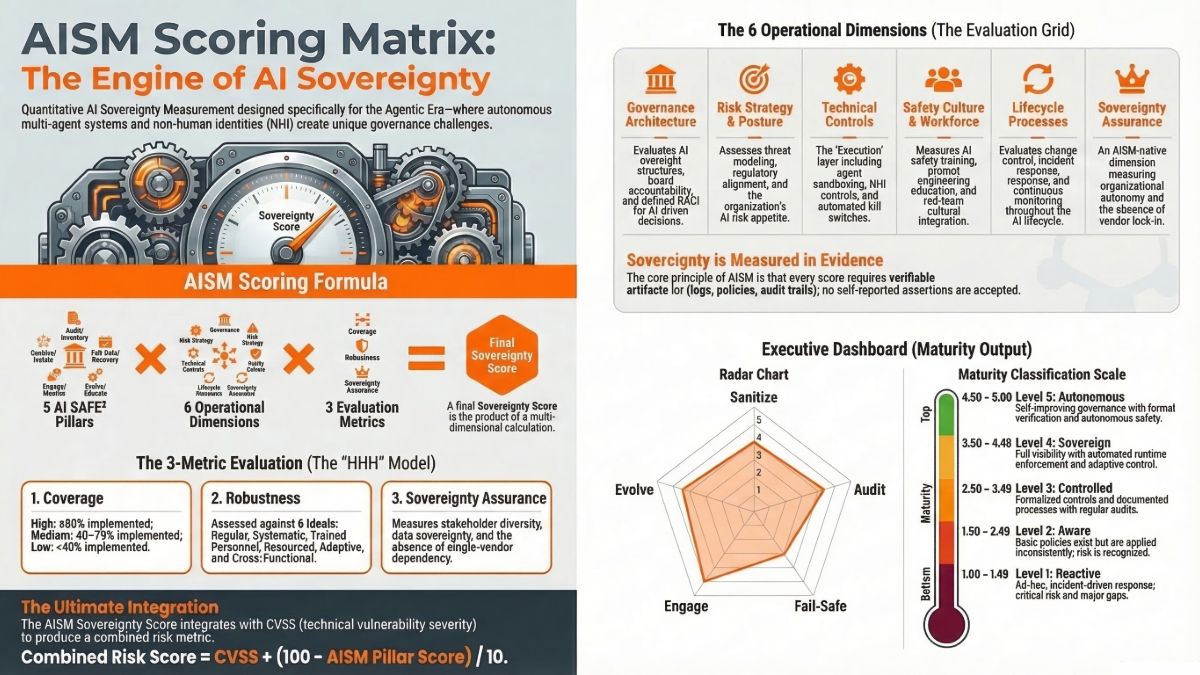
Each AI SAFE2 pillar is assessed across six scoring dimensions — adapted from digital maturity research and agentic AI requirements:
| # | Dimension | DMM Equivalent | Agentic AI Application |
|---|---|---|---|
| D1 | Governance Architecture | Organization (36) | AI oversight structures, board accountability, RACI for AI decisions, sovereignty posture |
| D2 | Risk Strategy & Posture | Strategy (34) | AI risk appetite, threat modeling, sovereignty roadmap, regulatory alignment |
| D3 | Technical Controls | Technology (28) | Agent sandboxing, NHI controls, memory security, supply chain signing, kill switches |
| D4 | Safety Culture & Workforce | Culture (27) | AI safety training, prompt engineering education, agentic system awareness, red team culture |
| D5 | Lifecycle Processes | Process (21) | AI system lifecycle management, change control, incident response, continuous monitoring |
| D6 | Sovereignty Assurance | NEW — AISM-native | Organizational autonomy over AI, data sovereignty, model provenance, self-governance capability |
3.4 Three-Metric Evaluation (Per Dimension Per Pillar)
Each of the 30 assessment cells (5 pillars × 6 dimensions) is scored using three metrics, each rated Low (L), Medium (M), or High (H):
Metric 1: Coverage
How completely does the organization implement the relevant AI SAFE2 subtopics?
| Rating | Criteria |
|---|---|
| High | ≥80% of applicable subtopics implemented with documented controls |
| Medium | 40–79% of applicable subtopics implemented |
| Low | <40% of applicable subtopics implemented |
Metric 2: Robustness
How rigorous and resilient are the implemented controls?
Assessed against six robustness ideals (adapted from NIST implementation tiers):
- Regular — Controls executed routinely, not ad-hoc
- Systematic — Organization-wide policies, not team-specific
- Trained Personnel — Roles defined, staff certified/trained
- Sufficiently Resourced — Budget, tools, compute allocated
- Adaptive — Controls evolve with threat landscape; regular reviews
- Cross-Functional — Involves security, engineering, legal, leadership
| Rating | Criteria |
|---|---|
| High | 5–6 robustness ideals satisfied |
| Medium | 3–4 robustness ideals satisfied |
| Low | 0–2 robustness ideals satisfied |
Metric 3: Stakeholder Diversity & Sovereignty Assurance
How diverse are inputs and how sovereign is organizational control?
This metric extends the IEEE model’s “Input Diversity” to include sovereignty:
| Rating | Criteria |
|---|---|
| High | Diverse internal/external stakeholders inform controls; organization maintains full autonomous control over AI governance decisions; no single vendor lock-in |
| Medium | Some stakeholder diversity; partial organizational control; moderate vendor dependencies |
| Low | Minimal stakeholder input; governance decisions driven by single team or vendor; significant sovereignty gaps |
3.5 Score Calculation
Cell Score (1–5)
Each cell uses the HHH rubric from the IEEE/NIST AI RMF model:
| Score | Metric Combination | Point Total (L=1, M=2, H=3) |
|---|---|---|
| 5 | HHH | 9 |
| 4 | HHM | 8 |
| 3 | HMM, HHL, HML, MMM | 6–7 |
| 2 | MML, MLL, HLL | 4–5 |
| 1 | LLL | 3 |
Pillar Score
Each pillar score is the weighted average of its 6 dimension scores, with weights calibrated by expert panel (adapted from Bernardo et al. methodology):
Pillar Score = Σ (Dimension Score × Dimension Weight) / Σ Dimension Weights
Default weights (adjustable per organizational context):
| Dimension | Default Weight | Rationale |
|---|---|---|
| D1: Governance Architecture | 0.20 | Foundation — without governance, controls are ad-hoc |
| D2: Risk Strategy & Posture | 0.18 | Direction — strategy determines investment priorities |
| D3: Technical Controls | 0.25 | Execution — largest subtopic coverage in AI SAFE2 |
| D4: Safety Culture & Workforce | 0.12 | Enablement — people execute controls |
| D5: Lifecycle Processes | 0.15 | Operations — day-to-day process maturity |
| D6: Sovereignty Assurance | 0.10 | Differentiation — unique to AISM |
Overall AISM Sovereignty Score
AISM Score = Σ (Pillar Score × Pillar Weight) / Σ Pillar Weights
Default pillar weights (equal by default, adjustable):
| Pillar | Default Weight |
|---|---|
| P1: Sanitize / Isolate | 0.20 |
| P2: Audit / Inventory | 0.20 |
| P3: Fail-Safe / Recovery | 0.20 |
| P4: Engage / Monitor | 0.20 |
| P5: Evolve / Educate | 0.20 |
3.6 Combined Risk Score Integration
For organizations also tracking technical vulnerabilities, AISM integrates with CVSS and the AI SAFE2 v3.1 combined-risk method:
Combined Risk = CVSS Base Score × ((100 - Pillar Score as %) / 10)
Example: CVSS 8.5 (High) + AISM Pillar Score 3.8/5.0 (76%) = 8.5 × (24/10) = 20.4 → High Risk
Example: CVSS 8.5 (High) + AISM Pillar Score 4.5/5.0 (90%) = 8.5 × (10/10) = 8.5 → Moderate Risk
4. AI Sovereignty Matrix Visualization
4.1 Sovereignty Matrix Plot
The AISM Sovereignty Score is visualized as a radar chart (spider diagram) with:
- 5 axes = 5 AI SAFE2 Pillars
- 5 concentric rings = Maturity Levels 1–5
- Color coding = Red (1–2), Yellow (3), Green (4–5)
Additionally, a heatmap matrix plots:
- Rows = 5 Pillars (P1–P5)
- Columns = 6 Dimensions (D1–D6)
- Cell values = Score (1–5) with color gradient
4.2 Maturity Classification
| AISM Score Range | Canonical Maturity Level | Risk Posture | Action Required |
|---|---|---|---|
| 4.50 – 5.00 | Sovereignty | Sovereign | Maintain excellence; share best practices |
| 3.50 – 4.49 | Control | Controlled | Close specific gaps; advance to Sovereignty |
| 2.50 – 3.49 | Governance | Developing | Prioritize critical pillars; formalize controls |
| 1.50 – 2.49 | Visibility | Emerging | Establish baseline governance immediately |
| 1.00 – 1.49 | Chaos | Exposed | Critical risk — immediate intervention required |
Canonical maturity names come from maturity-model.md. Risk-posture labels describe urgency and must not be emitted as maturity levels.
5. Evidence Requirements
Every score must be substantiated with verifiable evidence. The AISM requires three categories of evidence per assessment cell:
| Evidence Type | Description | Examples |
|---|---|---|
| Documentary | Written policies, procedures, architecture documents | AI governance policy, agent inventory, SBOM records |
| Operational | Logs, dashboards, audit trails demonstrating active controls | SIEM logs showing NHI monitoring, kill switch test records |
| Attestation | Third-party or cross-functional verification | Penetration test reports, red team findings, compliance audit results |
6. Comparison: AISM vs. Current Approaches
| Capability | AISM (Recommended) | IEEE/NIST MM | CSA AICM | MS RAI MM | NIST CSF MM |
|---|---|---|---|---|---|
| Maturity levels | 5 (Reactive→Autonomous) | 5 (1–5 scale) | 3 (STAR levels) | 5 (Latent→Leading) | 5 (Very Poor→Excellent) |
| Scoring metrics | 3 (Coverage, Robustness, Sovereignty) | 3 (Coverage, Robustness, Diversity) | Binary (Y/N/Partial) | Level criteria | Weighted surveys |
| Agentic AI controls | ✅ 35 sub-domains | ❌ None | ⚠️ Limited | ❌ None | ❌ None |
| NHI governance | ✅ 10 dedicated controls | ❌ None | ⚠️ Minimal | ❌ None | ❌ None |
| Supply chain signing | ✅ OpenSSF OMS | ❌ None | ⚠️ General | ❌ None | ❌ None |
| Memory security | ✅ 6 sub-domains | ❌ None | ❌ None | ❌ None | ❌ None |
| Sovereignty dimension | ✅ Native | ❌ None | ❌ None | ❌ None | ❌ None |
| Compliance crosswalks | ✅ 7+ frameworks | ⚠️ NIST AI RMF only | ✅ ISO 42001, NIST | ❌ None | ⚠️ NIST CSF only |
| Evidence requirements | ✅ 3 categories | ✅ Evidence-based | ⚠️ Questionnaire | ❌ Guidance only | ⚠️ Survey-based |
7. References
- Dotan, R., Blili-Hamelin, B., Madhavan, R., Matthews, J., & Scarpino, J. (2024). “Evolving AI Risk Management: A Maturity Model based on the NIST AI Risk Management Framework.” arXiv:2401.15229v1.
- IEEE USA. (2025). “A Flexible Maturity Model for AI Governance Based on the NIST AI Risk Management Framework.”
- Bernardo, L., Malta, S., & Magalhães, J. (2025). “An Evaluation Framework for Cybersecurity Maturity Aligned with the NIST CSF.” Electronics 2025, 14, 1364.
- Darling, M.C., et al. (2026). “Toward Maturity-Based Certification of Embodied AI.” arXiv:2601.03470.
- Cloud Security Alliance. (2025). “AI Controls Matrix (AICM) v1.0.” 243 control objectives, 18 security domains.
- Vorvoreanu, M., et al. (2023). “Responsible AI Maturity Model.” Microsoft Research.
- NIST. (2025). “Cybersecurity Framework Profile for Artificial Intelligence.” NIST IR 8596 iprd.
- NIST. (2023). “AI Risk Management Framework (AI RMF 1.0).” NIST AI 100-1.
- Peixoto, E.C., et al. (2025). “Clarifying Core Dimensions in Digital Maturity Models.” arXiv:2602.07569v1.
- Cyber Strategy Institute. (2026). “AI SAFE2 Framework Version 3.1 — Protocol Governance and Enforcement Plane Update.”
- RAI Institute. (2024). “Responsible AI Maturity Model.” Five stages: Aware → Transformative.
- iQomply. (2026). “ISO 42001 Maturity Model.” Five levels: Initial → Mature.
© 2026 Cyber Strategy Institute. Licensed under Creative Commons Attribution 4.0 International (CC BY 4.0).