# AI Sovereign Maturity (AISM) Model
### The maturity and operating model for deterministic governance of probabilistic AI
**Documentation updated:** 2026-10-13. AISM now houses the full Sovereignty Score,
Technology Contribution Profile (TCP), and Evidence Assurance v1.0 methods,
with the Technology Card and evidence-collection workflow.
See the [assessment guide](./ASSESSMENT-GUIDE.md) for the three instruments,
Technology Card workflow, and worked example. Original methodology dates below
identify their baseline; this update does not change scoring formulas.
[](../README.md)
[](./README.md)
[](../EVOLUTION.md)
[Framework Home](../README.md) | [Cross-Pillar Governance](../00-cross-pillar/README.md) | [Pillar 1](../01-sanitize-isolate/README.md) | [NEXUS](../NEXUS/) | [Dashboard](https://cyberstrategyinstitute.github.io/ai-safe2-framework/dashboard/)
**Previous:** [← Cross-Pillar Governance](../00-cross-pillar/README.md) | **Next:** [NEXUS →](../NEXUS/)
**Tagline:** *"The Operating System for Safe Autonomous AI"*
**Core Principle:** *Probabilistic intelligence requires deterministic control.*
**Organization:** Cyber Strategy Institute
**Framework:** AI SAFE² v3.1
**Framework release context:** August 2026; assessment-method documentation updated October 2026
---
## Choose your assessment
Use AISM to assess organizational maturity or evaluate what a product, solution,
or technique contributes to specific controls. The full methods and review
records live here in `/AISM`.
| Your goal | Start here | Result |
|---|---|---|
| Assess organizational maturity | [Sovereignty Score methodology](./AISM-Scoring-Matrix-Methodology.md) and [self-assessment](./AISM-Self-Assessment-Tool.md) | Organizational maturity across five pillars and six dimensions |
| Evaluate a product, solution, or technique | [Technology Contribution Profile v1.0](./TECHNOLOGY-CONTRIBUTION-PROFILE.md) | Scoped control effects, contribution, coverage, and adoption conditions |
| Evaluate the evidence behind a claim | [Evidence Assurance Level v1.0](./EVIDENCE-ASSURANCE.md) | Claim-level E0-E5 assessment with provenance, independence, and limits |
| Collect evidence from a provider or internal owner | [Technology evidence request](./TECHNOLOGY-EVIDENCE-REQUEST.md) and [Technology Card](./templates/TECHNOLOGY-CARD.md) | A reviewable evidence record and explicit gaps |
## Evaluate a technology in four steps
1. **Define the gap and subject:** identify required controls, exact version,
intended deployment, and excluded paths using the [TCP workflow](./TECHNOLOGY-CONTRIBUTION-PROFILE.md#assessment-workflow).
2. **Request and collect evidence:** copy the [provider evidence request](./TECHNOLOGY-EVIDENCE-REQUEST.md#copyable-request-to-a-provider-or-internal-owner)
and record the response in a [Technology Card](./templates/TECHNOLOGY-CARD.md).
3. **Evaluate contribution and assurance separately:** map demonstrated effects
to controls with TCP, then apply the [Evidence Assurance rubric](./EVIDENCE-ASSURANCE.md#rubric-and-status)
to each claim. Preserve missing evidence, failures, and limits.
4. **Decide the next action:** use the [adoption rule](./TECHNOLOGY-CONTRIBUTION-PROFILE.md#purchasing-and-adoption-rule)
to record adopt, pilot, hold, or reject, with a named owner and acceptance tests.
Use the [assessment guide](./ASSESSMENT-GUIDE.md) for a worked example,
[validation guide](./TECHNOLOGY-VALIDATION.md) for test planning, and
[incident evidence guide](./INCIDENT-EVIDENCE.md) for reconstruction and follow-up.
The output supports a human decision; it does not authorize deployment or certify a product.
## Organizational maturity and technology contribution
The Sovereignty Score assesses an organization across five pillars and six
dimensions. Use the [Technology Contribution Profile](TECHNOLOGY-CONTRIBUTION-PROFILE.md)
for a product, paper, benchmark, technique, investigation, or accountability input.
Record its control effects and scoped contribution alongside the [Evidence Assurance Level](EVIDENCE-ASSURANCE.md); neither determines
organizational maturity. Start with the [Technology Card](templates/TECHNOLOGY-CARD.md)
and [nine examples](../research/technology-contribution-examples.md).
The existing CLI's E0-E5 numeric grades are separate from assurance v1.0 and keep
their current formulas and verification caps. No TCP command is implemented here.
## Why AISM Exists
AI systems are probabilistic by nature. They hallucinate, drift, and behave unexpectedly under novel conditions. Yet most organizations deploy them with governance designed for static software: write a policy, run an audit, repeat annually.
That approach fails for autonomous agents.
The **AI Sovereign Maturity (AISM) Model** exists because agentic AI systems require governance that operates at runtime, not just at policy review time. When an agent is autonomously executing tasks, chaining tool calls, and orchestrating other agents, a PDF policy document offers no protection. What you need is deterministic control layered over probabilistic behavior, enforced continuously, and measurable at every stage.
AISM provides exactly that.
### Relationship to AI SAFE² v3.1
**Naming:** AISM expands to **AI Sovereign Maturity**; Model follows the acronym.
Use **AISM** or **AISM Model** after the first mention. Sovereign refers to the
organization's retained authority over AI. The Sovereignty Score and Sovereignty
Matrix retain their names as distinct instruments within the model.
AI SAFE² defines the control and evidence requirements. AISM provides the maturity model used to measure how completely and robustly an organization has operationalized those requirements.
Version 3.1 does not replace the five AISM maturity levels. It strengthens the operating model around protocol governance, agent-to-tool enforcement, session-independent state semantics, and the separation between framework requirements and reference implementations.
---
## What Makes AISM Different
AISM was purpose-built for agentic systems where autonomy, non-human identity, memory, delegation, runtime enforcement, and continuous evidence all matter.
| Capability | AISM focus |
|---|---|
| Agentic AI controls | Multi-agent, swarm, A2A, tool, and orchestration governance |
| Non-human identity | Agent and service-identity lifecycle, authorization, delegation, and ownership |
| Supply chain | Provenance, model signing, software/tool integrity, and protocol profiles |
| Memory and context security | RAG, memory poisoning, state governance, and persistence scope |
| Sovereignty | Organizational control over AI authority and decision rights |
| Runtime enforcement | Deterministic constraints around probabilistic systems |
| Compliance reuse | Crosswalks that let one evidence set support multiple frameworks |
| Evidence-based scoring | Coverage, robustness, and sovereignty assurance rather than self-attestation alone |
---
## The AISM Value Proposition
### For Security and Risk Leaders
AISM gives you measurable risk posture across AI systems. It helps answer: what is our blast radius if an agent misbehaves? Which pillar is weakest? Where is human authority missing? Which high-autonomy deployments lack sufficient runtime controls?
### For AI and Engineering Teams
AISM translates governance policy into a concrete technical control stack. Every pillar maps to implementation decisions: input sanitization, agent sandboxing, tool authorization, kill switches, memory boundaries, protocol enforcement, and audit evidence.
### For Compliance and Legal Teams
AISM organizes evidence so controls can be mapped across relevant AI, cybersecurity, privacy, and enterprise governance frameworks without running a separate governance program for each one.
### For Executive Leadership
AISM produces an organizational maturity view on a 1-to-5 scale, showing where control exists, where it is weak, and what should be prioritized next.
---
## The Five Pillars at a Glance
| Pillar | AI-Native Name | What It Governs |
|---|---|---|
| P1 | **Shield** | Input sanitization, prompt injection prevention, data isolation, agent sandboxing, boundary enforcement |
| P2 | **Ledger** | Audit trails, agent behavior logging, asset registry, model inventory, provenance and evidence |
| P3 | **Circuit Breaker** | Kill switches, fail-safe mechanisms, rate limiting, rollback, recovery, continuity |
| P4 | **Command Center** | Human oversight, anomaly detection, intervention workflows, runtime monitoring |
| P5 | **Learning Engine** | Red teaming, threat intelligence, training, evaluation, continuous adversarial learning |
The Cross-Pillar Governance Layer applies across all five pillars and adds ACT tiers, control-plane governance, protocol profiles, catastrophic-risk thresholds, replication governance, and HEAR authority.
---
## The Five Maturity Levels
| Level | Name | What It Means |
|---|---|---|
| 1 | **Chaos** | Ad hoc AI experiments. No reliable containment, logging, ownership, or oversight. |
| 2 | **Visibility** | Logging and basic containment exist. Operational awareness is improving but controls are inconsistent. |
| 3 | **Governance** | Policies and required controls are defined, assigned, and auditable. |
| 4 | **Control** | Runtime governors enforce deterministic boundaries. Evidence and risk metrics are continuously available. |
| 5 | **Sovereignty** | Full organizational control over identity, delegation, data, evidence, fail-safe authority, and continuous adversarial adaptation. |
---
## The Full AISM Ecosystem
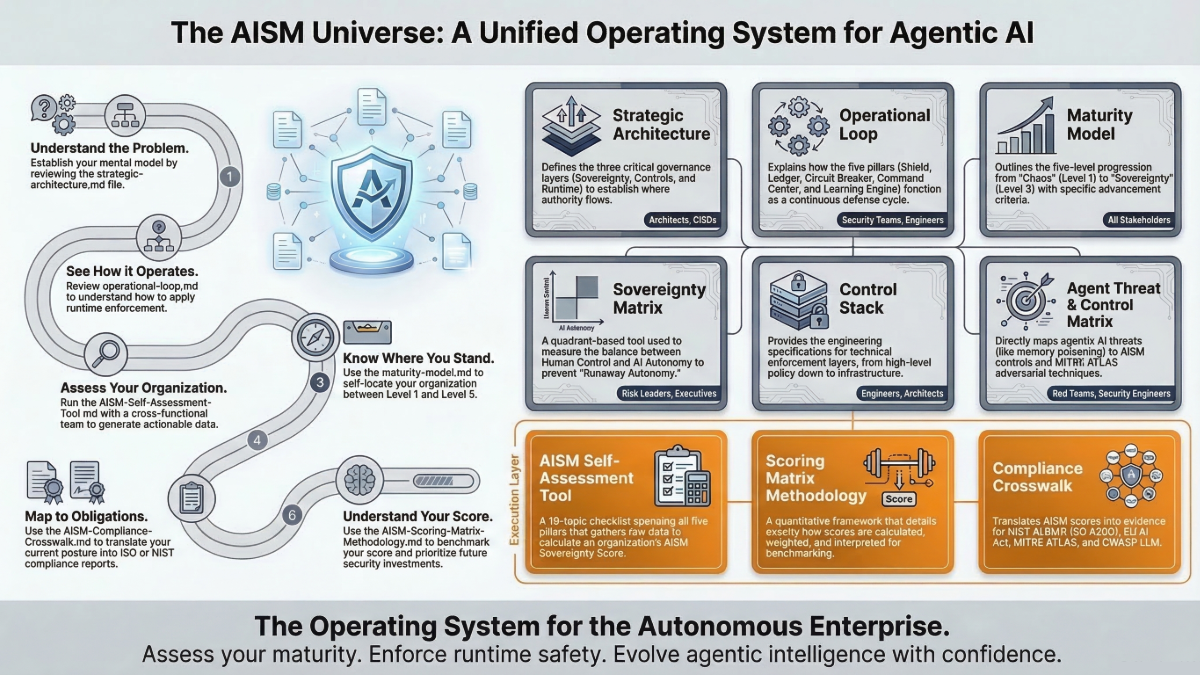
### Core Framework Documents
| File | Purpose | Audience |
|---|---|---|
| [strategic-architecture.md](./strategic-architecture.md) | Three-layer governance architecture: Sovereignty, Controls, Runtime | Architects, CISOs |
| [operational-loop.md](./operational-loop.md) | How the five pillars operate as a continuous defense cycle | Security teams, engineers |
| [sovereignty-matrix.md](./sovereignty-matrix.md) | Human control vs. AI autonomy quadrant | Risk leaders, executives |
| [maturity-model.md](./maturity-model.md) | Five-level progression from Chaos to Sovereignty | All stakeholders |
| [control-stack.md](./control-stack.md) | Technical enforcement layers from policy to infrastructure | Engineers, architects |
| [agent-threat-control-matrix.md](./agent-threat-control-matrix.md) | Agentic threat landscape mapped to AISM controls and threat references | Red teams, security engineers |
### Assessment and Measurement Tools
| File | Purpose | Audience |
|---|---|---|
| [AISM-Self-Assessment-Tool.md](./AISM-Self-Assessment-Tool.md) | 10-topic checklist across the five pillars | Security teams, compliance |
| [AISM-Scoring-Matrix-Methodology.md](./AISM-Scoring-Matrix-Methodology.md) | Quantitative scoring methodology | Framework practitioners |
| [AISM-Compliance-Crosswalk.md](./AISM-Compliance-Crosswalk.md) | Cross-framework control mapping | Compliance, audit, procurement |
---
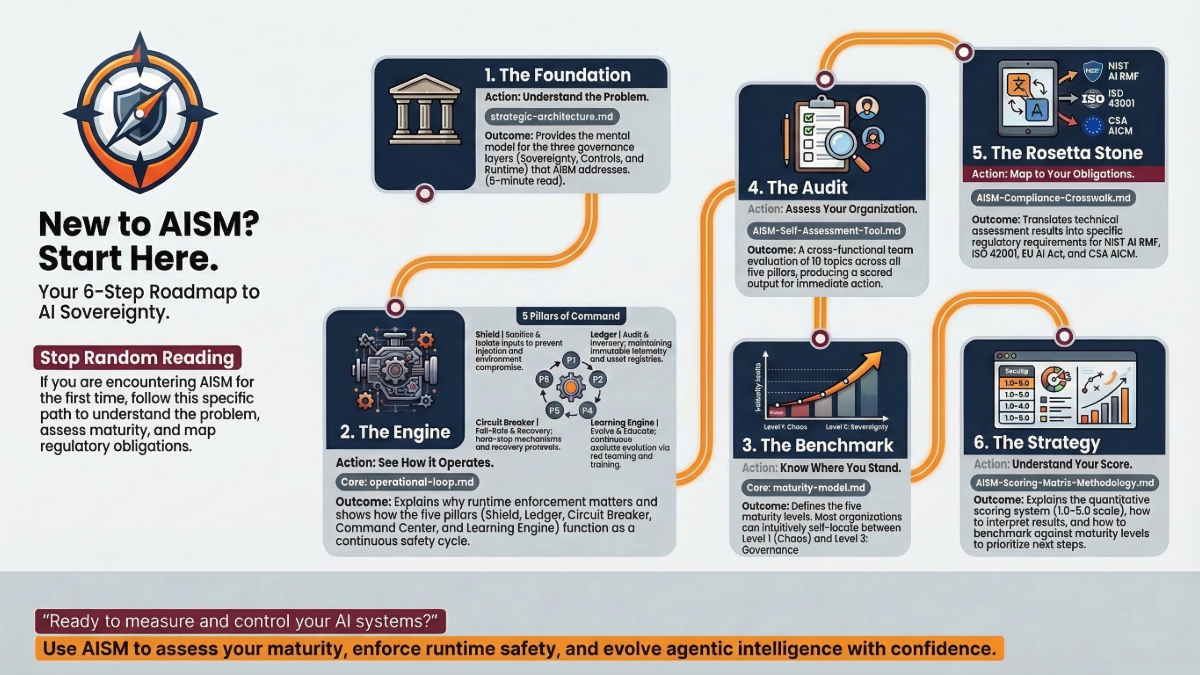
## New to AISM? Start Here
1. **Understand the architecture:** read [strategic-architecture.md](./strategic-architecture.md).
2. **See the operating loop:** read [operational-loop.md](./operational-loop.md).
3. **Locate your maturity:** read [maturity-model.md](./maturity-model.md).
4. **Assess your organization:** use [AISM-Self-Assessment-Tool.md](./AISM-Self-Assessment-Tool.md).
5. **Map obligations:** use [AISM-Compliance-Crosswalk.md](./AISM-Compliance-Crosswalk.md).
6. **Interpret the score:** read [AISM-Scoring-Matrix-Methodology.md](./AISM-Scoring-Matrix-Methodology.md).
---
## Scoring in 60 Seconds
Each assessment topic is rated across three dimensions:
- **Coverage:** how completely the required controls are implemented;
- **Robustness:** how strongly and consistently those controls are enforced;
- **Sovereignty Assurance:** how much effective organizational control exists over AI authority, evidence, and fail-safe behavior.
Topic scores roll into pillar scores, then into the overall AISM maturity view. The purpose is not to reward documentation volume. It is to measure whether governance exists in practice and can be evidenced.
For methodology details, see [AISM-Scoring-Matrix-Methodology.md](./AISM-Scoring-Matrix-Methodology.md).
### AISM Decision Card
The `safe2 aism` command operationalizes the documented three-metric, five-pillar
model without turning missing evidence into a pass. It produces canonical JSON
for agents and a compact Decision Card for accountable humans:
```bash
safe2 aism init assessment.json
safe2 evidence nexus ./NEXUS --output nexus-evidence.json
safe2 aism ingest nexus-evidence.json --subject-id nexus-local --subject-name "NEXUS Local" --output assessment.json
safe2 aism score assessment.json --format markdown --output decision-card.md
safe2 aism score assessment.json --format json --output decision.json
safe2 aism compare previous.json current.json
safe2 aism remediation-init assessment.json --system-identity system-identity.json --assessment-scope assessment-scope.json --decision-owner "CISO" --output remediation-source.json
safe2 aism plan remediation-source.json assessment.json --system-identity system-identity.json --assessment-scope assessment-scope.json --output remediation-plan.json --card remediation-card.md --strict
```
`ingest` preserves the provider bundle, suggests candidate cells, and requires human confirmation. It never converts scanner presence or endpoint availability directly into maturity ratings. Unverified evidence is explicitly capped in the supplemental decision-support score.
The raw AISM Sovereignty Score remains the normative maturity score. A separately
labeled evidence-adjusted score discounts weak substantiation for decision
support. It does not create another maturity level or claim conformance.
Probability ranges must name an outcome, time horizon, method, and confidence.
When comparable evidence does not exist, the correct result is `NOT ESTIMABLE`,
not an invented percentage.
CLI 0.8 adds a separate remediation contract. Each action must name applicable
AI SAFE² controls and AISM cells, available evidence, stated assumptions, an
owner, dependencies, alternatives, impacts, exit criteria, and residual risk.
Completed actions require available completion evidence. Reassessment records
status transitions without silently changing the normative maturity score or
authorizing implementation.
See the [AISM remediation guide](../safe2/docs/AISM-REMEDIATION.md).
See the executable [Decision Card example](../examples/aism-decision-card/).
---
## Regulatory and Framework Coverage
AISM and AI SAFE² maintain mappings across major AI, cybersecurity, privacy, resilience, and enterprise governance frameworks. Representative mappings include:
- NIST AI RMF;
- NIST CSF 2.0;
- ISO/IEC 42001;
- ISO/IEC 27001;
- OWASP LLM and agentic guidance;
- MITRE ATLAS;
- EU AI Act;
- SOC 2;
- NIST SP 800-53;
- FedRAMP and CMMC where applicable;
- GSAR Unbiased AI requirements through the UAS regulatory profile extension.
The crosswalk supports evidence reuse. It does not replace an organization's obligation to determine applicability or certification requirements independently.
---
## v3.1 Implementation Notes
AISM v3.1 uses the same repository-wide distinctions as the framework:
- **161** is the AI SAFE² core framework control count.
- **MCP-1 through MCP-19** are CP.5.MCP profile controls and do not increase the core count to 180.
- **UAS 1.0** is a regulatory profile extension that composes 27 mapped profile requirements. It does not add to the 161-control core or create CP.11 as a core control.
- **NEXUS** is CSI's reference implementation, not a mandatory dependency for AI SAFE² conformance.
- Governance should bind to verified principals, capability grants, delegation, policy, and explicit state handles rather than protocol-owned session constructs.
---
## Who Uses AISM
**Government and public sector:** organizations that need auditable AI governance tied to policy, security, acquisition, and operational evidence.
**Enterprises:** organizations that need measurable AI governance across engineering, security, legal, risk, and procurement.
**Critical infrastructure operators:** environments where autonomous failure can create operational or safety consequences.
**AI and security teams:** builders who need technical control guidance for multi-agent, tool-using, and autonomous systems.
---
## Start Here
- [Run the AISM Self-Assessment](./AISM-Self-Assessment-Tool.md)
- [Understand the Scoring Methodology](./AISM-Scoring-Matrix-Methodology.md)
- [Review the Compliance Crosswalk](./AISM-Compliance-Crosswalk.md)
- [Review the AI SAFE² v3.1 Framework](../README.md)
---
## 🔗 Navigation
| Previous | Current | Next |
|---|---|---|
| [Cross-Pillar Governance](../00-cross-pillar/README.md) | **AISM** | [NEXUS](../NEXUS/) |
[Framework Home](../README.md) | [Pillar 1](../01-sanitize-isolate/README.md) | [Cross-Pillar Governance](../00-cross-pillar/README.md) | [NEXUS](../NEXUS/) | [Dashboard](https://cyberstrategyinstitute.github.io/ai-safe2-framework/dashboard/) | [Repository UX Standard](../docs/REPOSITORY-UX-STANDARD.md)
---
*AI SAFE² v3.1 · © 2026 [Cyber Strategy Institute](https://cyberstrategyinstitute.com/ai-safe2/)*